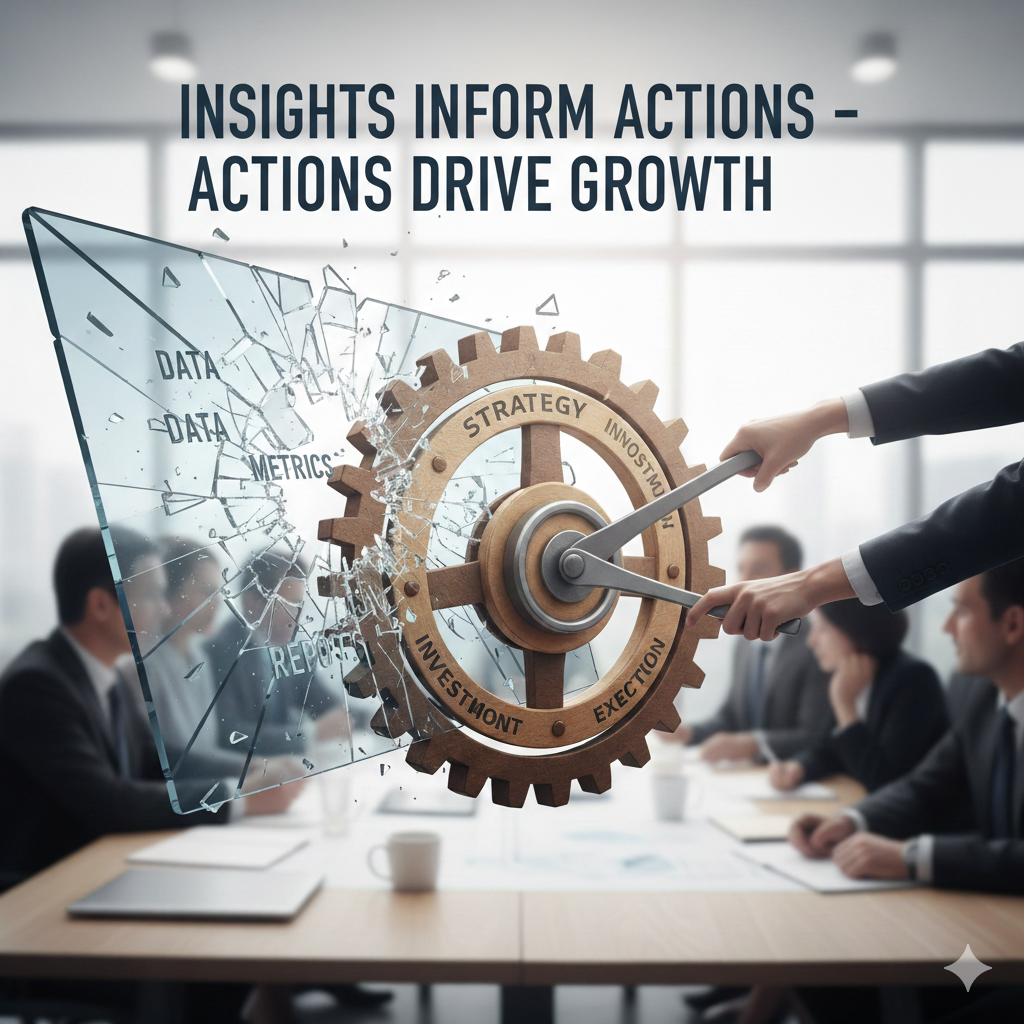
In today’s corporate environment, glowing dashboards have become symbols of progress. Screens filled with colourful graphs, live KPIs, and performance meters give the impression that a business is fully in control. Yet many organizations proudly display advanced business intelligence systems while revenue stagnates, costs rise, and opportunities slip away. The uncomfortable reality is simple: dashboards do not create growth. Decisions do. Data visualization is a tool, not a strategy. Without timely and well-informed action, even the most sophisticated reporting infrastructure remains decorative.
Modern companies generate vast amounts of data from CRM systems, ERP platforms, marketing campaigns, customer interactions, supply chain operations, and financial transactions. With the expansion of cloud-based analytics, accessing information has become easier than ever. However, accessibility does not guarantee impact. Many businesses assume that once dashboards are implemented, growth will automatically follow. In truth, dashboards only present information. They do not interpret it, prioritize it, or act on it. One common mistake organizations make is confusing visibility with velocity. Dashboards improve visibility by showing what is happening in real time. But growth requires velocity swift and strategic responses to what is happening. If sales conversion rates decline and leadership waits weeks to respond, the dashboard becomes a passive observer rather than a catalyst. The gap between insight and execution is where growth is either accelerated or lost.
Another reason dashboards fail to drive growth is the overload of vanity metrics. Many teams track impressions, page views, downloads, and surface-level engagement without connecting them to profitability. Metrics without context create a false sense of progress. For example, a spike in website traffic might look impressive on a dashboard, but if conversion rates drop simultaneously, overall performance may be weakening. Effective data analytics focuses on actionable indicators that influence revenue, cost efficiency, and customer retention. Growth-oriented companies differentiate between descriptive analytics and strategic decision-making. Descriptive analytics answers the question, “What happened?” It shows last month’s revenue, operational delays, or campaign reach. But strategic decisions require answering, “What should we do next?” This progression demands predictive analytics and scenario modelling. Leaders must interpret patterns, assess risk, and choose deliberate actions based on evidence.
Cultural barriers often prevent dashboards from influencing real outcomes. In many organizations, reports are reviewed in meetings but rarely challenged. When executives rely more heavily on intuition than on data-backed evidence, dashboards become ceremonial rather than transformational. Building a genuine data-driven culture requires leaders to encourage debate grounded in analysis. Data must not simply inform discussions; it must shape final decisions. Consider operational efficiency. A logistics firm may monitor delivery timelines through real-time dashboards, identifying late shipments or fuel cost spikes. However, if management does not adjust routes, renegotiate supplier contracts, or implement route optimization algorithms, performance remains unchanged. Dashboards highlight problems; leadership resolves them. Growth depends on translating insights into operational reform.
Financial planning provides another clear example. Budget dashboards often track monthly expenditure against forecasts. Yet, when variance appears, businesses frequently rationalize rather than respond. Through structured financial analytics, companies can perform scenario simulations testing how cost fluctuations, seasonal demand changes, or pricing adjustments affect profitability. The difference between observing budget variance and restructuring financial strategy determines whether growth occurs. Marketing departments often invest heavily in performance dashboards but fail to connect analytics with long-term value creation. Tracking clicks and engagement without integrating customer lifetime value analysis leads to short-term thinking. By combining campaign data with customer analytics, organizations can identify high-retention segments and allocate resources strategically. Growth emerges not from viewing campaign reports but from reallocating budgets based on those insights.
A critical but overlooked dimension is decision latency the time between insight and action. High-performing organizations minimize this delay through automated alerts and AI-powered analytics. When churn probability rises above a threshold, retention campaigns trigger automatically. When inventory levels fall below safety stock, replenishment systems respond instantly. Automation converts data into rapid action, reducing dependence on manual review cycles.
Technology alone, however, does not guarantee decisive action. Many companies implement advanced machine learning models yet lack structured governance to integrate outputs into workflows. Analytical outputs must be embedded into operational processes. For instance, predictive demand forecasts should directly influence procurement schedules and warehouse planning. Without integration, analytics remains isolated from execution. Leadership alignment is equally essential. Dashboards often present departmental metrics independently, reinforcing silos. Sales, marketing, operations, and finance each track separate KPIs. True growth requires data integration that provides a unified view of performance. When cross-functional insights inform strategic discussions, decisions reflect holistic understanding rather than fragmented perspectives.
Another barrier is the fear of accountability. Decisions carry consequences. Dashboards, in contrast, feel safe. Reviewing metrics does not require commitment; making strategic adjustments does. Organizations must cultivate environments where informed risk-taking is encouraged. Through structured data governance frameworks, decision-makers can rely on consistent and trustworthy information, reducing hesitation. The psychological aspect of decision-making also plays a role. Humans are prone to confirmation bias, interpreting dashboards in ways that support existing beliefs. To counter this, businesses should implement standardized data modelling approaches and documented evaluation criteria. Analytical rigor reduces subjective interpretation and increases confidence in strategic choices.
Employee capability further determines whether dashboards translate into growth. Teams require strong data literacy to interpret trends accurately and ask meaningful questions. Training programs that build analytical understanding empower staff to move beyond observation toward recommendation. When employees feel confident interpreting data, they contribute proactively to decision-making. Security and compliance considerations can sometimes limit data utilization. However, implementing robust data security protocols including encryption, access controls, and audit trails allows organizations to balance protection with collaboration. Secure data sharing fosters informed decisions across departments without compromising confidentiality.
Growth-oriented organizations also recognize that not all metrics deserve equal attention. Strategic clarity requires identifying a focused set of key performance indicators (KPIs) directly tied to long-term objectives. Tracking too many metrics dilutes focus. Concentrating on indicators that influence revenue growth, margin expansion, customer retention, and operational efficiency ensures dashboards remain aligned with strategy. In rapidly evolving markets, historical data alone is insufficient. Through advanced predictive modelling, companies anticipate demand fluctuations, pricing sensitivity, and competitive responses. Anticipation allows pre-emptive decisions rather than reactive adjustments. Growth is often captured by those who act before trends fully materialize.
For small and mid-sized enterprises, adopting advanced analytics may seem resource-intensive. Yet scalable AI-driven insights platforms now make sophisticated analysis accessible without massive infrastructure investments. The competitive advantage lies not in technology ownership but in disciplined execution of insights generated by that technology. Ultimately, dashboards represent a mirror. They reflect the state of the organization but cannot change it. Decisions represent movement. They reshape strategies, reallocate resources, and redefine priorities. A company may install state-of-the-art business intelligence systems, but unless leaders transform insights into operational shifts, growth remains theoretical.
Sustainable expansion demands an ecosystem where analytics, leadership, governance, and culture converge. Insight must flow seamlessly from dashboards into boardroom discussions, from boardroom decisions into operational workflows, and from workflows back into measurable outcomes. This feedback loop transforms static reporting into dynamic strategy. In competitive industries whether logistics, retail, financial services, or technology solutions speed and precision define success. Organizations that integrate real-time analytics, deep data analysis, and decisive leadership consistently outperform those that merely observe performance metrics. The advantage lies in execution.
The path forward is clear. Treat dashboards as instruments, not endpoints. Prioritize actionable insights over visual aesthetics. Reduce decision latency through automation. Align KPIs with strategic objectives. Foster a culture that values evidence-based action. When companies embrace these principles, dashboards evolve from passive displays into active drivers of strategic clarity. Growth does not emerge from screens filled with charts. It emerges from leaders willing to interpret those charts critically and act boldly. When insight transforms into execution, performance accelerates. When execution becomes consistent, growth becomes sustainable. Dashboards illuminate the path but only decisive action moves the organization forward.