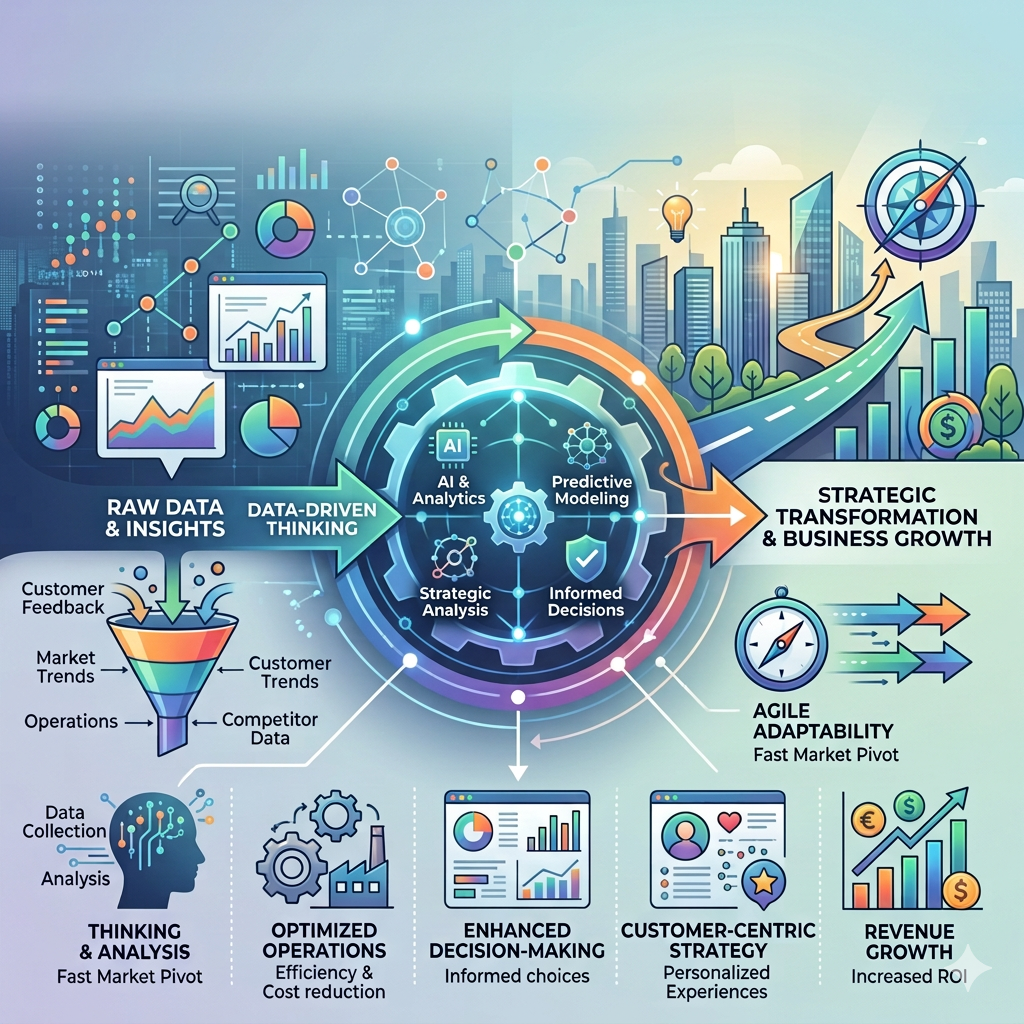
In today’s competitive and rapidly evolving business landscape, organizations are constantly required to make decisions that influence growth, profitability, and long-term sustainability. Traditionally, many of these decisions were based on experience, intuition, or established practices. While these approaches still have value, they are often insufficient in an environment where markets shift quickly and data is generated at unprecedented levels. This is where data-driven thinking becomes essential. Understanding how data-driven thinking can transform business strategy reveals how organizations can move from reactive decision-making to proactive, evidence-based planning.
At its core, data-driven thinking refers to the practice of using data as a primary foundation for decision-making rather than relying solely on assumptions or intuition. It does not eliminate human judgment but enhances it by providing factual insights that support or challenge existing beliefs. When organizations adopt this mindset, they begin to view data not just as a reporting tool but as a strategic asset.
One of the most significant ways data-driven thinking transforms strategy is by improving clarity in decision-making. Business strategies often involve complex choices related to pricing, market expansion, product development, and resource allocation. Without data, these decisions may depend heavily on subjective opinions or incomplete information. Data-driven thinking introduces measurable evidence into the process, allowing leaders to evaluate options based on real patterns and outcomes.
For example, instead of assuming which products are most valuable to customers, organizations can analyze purchasing behavior, customer feedback, and usage patterns. These insights help identify which offerings generate the most value and which require improvement.
Another major transformation occurs in strategic planning and forecasting. Traditional planning methods often rely on historical trends and general expectations. While these methods provide a starting point, they may not capture emerging changes in the market. Data-driven thinking incorporates advanced analytics and predictive models that estimate future scenarios based on current and historical data.
These forecasts allow businesses to prepare for changes in demand, anticipate market trends, and allocate resources more effectively. By understanding potential outcomes in advance, organizations can develop strategies that are both flexible and resilient.
Data-driven thinking also enhances customer-centric strategies. Modern businesses interact with customers across multiple channels, generating valuable data about preferences, behaviors, and engagement patterns. By analyzing this information, companies gain a deeper understanding of what customers value and how they make decisions.
These insights allow organizations to design personalized experiences, improve product offerings, and create targeted marketing campaigns. Instead of treating customers as a uniform group, businesses can tailor their strategies to specific segments, increasing both satisfaction and loyalty.
Another important impact of data-driven thinking is the ability to identify inefficiencies and optimize operations. Many organizations operate through complex systems involving production, logistics, workforce management, and service delivery. Without data analysis, inefficiencies within these systems may remain hidden.
Data-driven approaches examine operational metrics to identify bottlenecks, delays, and resource imbalances. By addressing these issues, organizations can reduce costs, improve productivity, and enhance overall performance.
Risk management is another area where data-driven thinking transforms strategy. Business environments are inherently uncertain, with risks related to financial performance, market changes, and operational disruptions. Data-driven analysis helps organizations identify potential risks early by examining patterns and trends within their data.
For example, financial data can reveal declining profit margins, while customer data may indicate increasing dissatisfaction. Recognizing these signals early allows businesses to take corrective action before problems escalate.
Another critical transformation involves measuring performance and accountability. Data-driven thinking encourages organizations to define clear metrics that reflect strategic objectives. By tracking these metrics consistently, businesses can evaluate whether their strategies are producing the desired outcomes.
This approach creates greater accountability across teams. When performance is measured through data, it becomes easier to identify areas that require improvement and ensure that decisions are aligned with organizational goals.
Data-driven thinking also challenges traditional assumptions and biases. Human judgment can be influenced by past experiences, personal preferences, or incomplete information. By introducing data into the decision-making process, organizations can test these assumptions and identify whether they hold true.
For example, a company may believe that a particular market segment is highly profitable, but data analysis may reveal that another segment generates higher returns. This insight allows businesses to adjust their strategies and focus on areas that deliver the most value.
Collaboration within organizations also improves when data-driven thinking is adopted. When decisions are supported by shared data, discussions become more objective and focused. Teams across departments can align their strategies based on common insights, reducing conflicts and improving coordination.
Another important aspect is the shift from reactive to proactive strategy. Traditional decision-making often responds to problems after they occur. Data-driven thinking enables organizations to anticipate challenges and opportunities before they fully develop.
For instance, predictive analytics can identify patterns that suggest future customer churn, allowing businesses to implement retention strategies in advance. This proactive approach reduces risk and improves long-term outcomes.
Technology plays a significant role in enabling data-driven strategies. Modern analytics platforms allow organizations to collect, process, and visualize data efficiently. These tools make it easier for decision-makers to understand complex relationships and communicate insights across teams.
However, adopting data-driven thinking requires more than technology. It involves building a culture that values evidence-based decision-making. Organizations must encourage employees to question assumptions, explore data, and integrate insights into everyday decisions.
Data quality is also essential for success. Accurate and reliable data ensures that analytical conclusions reflect real conditions. Without proper data governance, insights may become misleading and undermine strategic decisions.
Despite its advantages, data-driven thinking must be balanced with human judgment. Data provides valuable insights, but it may not capture every factor influencing a decision. Context, experience, and intuition still play important roles in interpreting data and applying it effectively.
Ultimately, how data-driven thinking can transform business strategy lies in its ability to connect information with action. By using data as a foundation for decisions, organizations can improve accuracy, reduce uncertainty, and respond more effectively to changing conditions.
In an increasingly complex business environment, the ability to make informed decisions is a critical advantage. Organizations that embrace data-driven thinking move beyond assumptions and develop strategies grounded in evidence. This approach not only improves performance but also creates a framework for continuous learning and adaptation.
By integrating data into every stage of strategic planning, businesses can build stronger, more resilient strategies that support long-term growth and success.