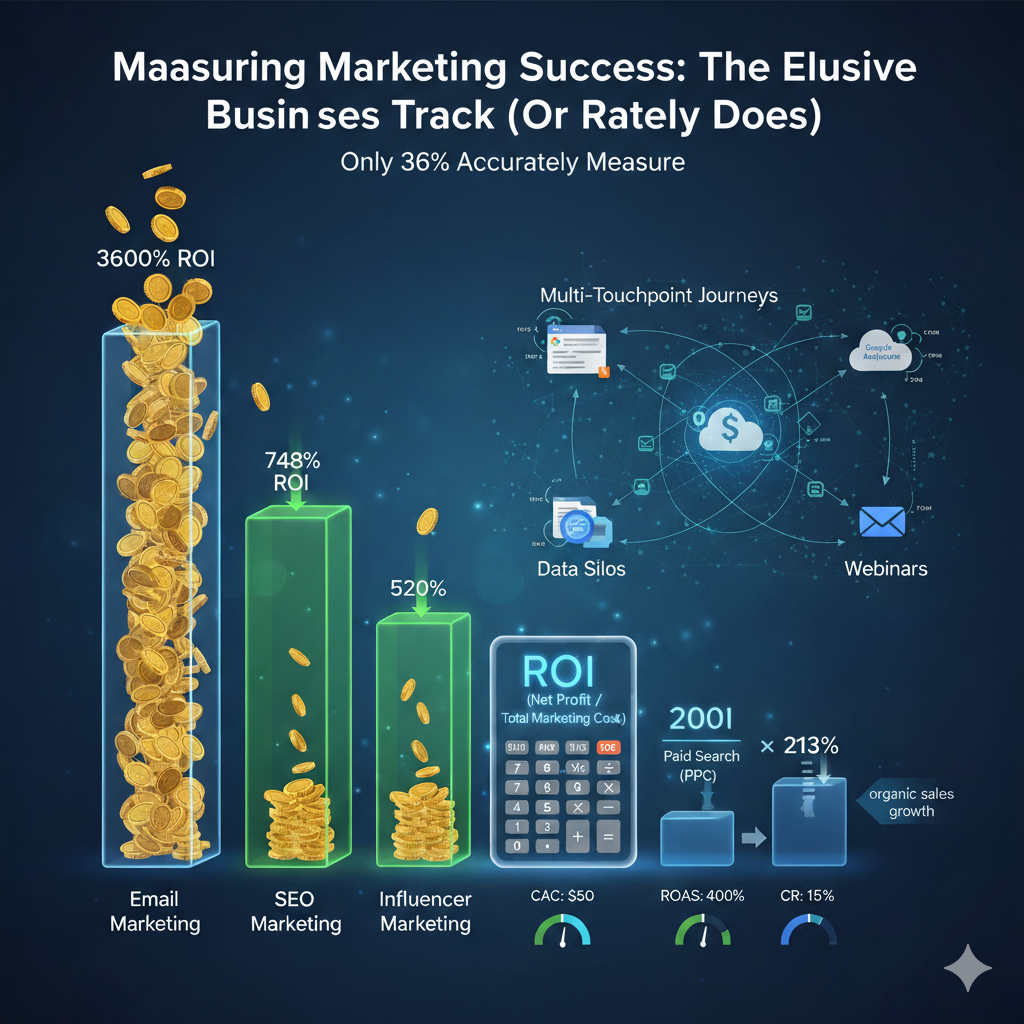
In boardrooms, pitch decks, quarterly reviews, and strategy meetings, one phrase appears with impressive consistency: Marketing ROI. It is cited as proof of accountability, performance, and strategic maturity. Leaders confidently speak about campaigns delivering measurable results, teams present dashboards filled with charts, and agencies promise data-driven growth. Yet beneath this confident language lies an uncomfortable reality while nearly every business claims to track Return on Investment (ROI) in marketing, very few truly measure it with precision, discipline, and clarity. The gap between claiming ROI and accurately calculating it is far wider than most organizations are willing to admit.
At its core, Marketing ROI is deceptively simple. It seeks to answer one fundamental question: for every unit of money invested in marketing, how much value is generated in return? In theory, the formula is straightforward subtract marketing costs from revenue generated, divide by marketing costs, and express the result as a percentage. However, real-world business environments are rarely simple. Revenue rarely originates from a single campaign. Customers interact with brands across multiple channels. Purchase decisions are influenced by awareness, trust, timing, and experience. As a result, accurately isolating marketing’s true contribution becomes complex. Many businesses avoid this complexity by relying on surface-level metrics instead of pursuing genuine ROI analysis.
One of the primary reasons businesses struggle with true ROI measurement is their fixation on vanity metrics. Metrics such as impressions, clicks, likes, shares, and website traffic are often celebrated as indicators of success. While these metrics provide useful signals about engagement and visibility, they do not directly measure profitability. A campaign may generate thousands of clicks and still produce minimal revenue. Another may produce modest traffic but generate high-value conversions. Without connecting engagement metrics to financial outcomes, businesses risk mistaking activity for impact. Tracking performance is not the same as tracking return.
Another obstacle lies in fragmented data systems. Marketing data often resides in multiple platforms advertising dashboards, social media analytics tools, CRM systems, email marketing software, and e-commerce portals. Sales data may exist in entirely different systems. Without data integration, calculating ROI requires manual effort, assumptions, or incomplete datasets. The result is either inaccurate measurement or avoidance altogether. Companies may claim to track ROI because they monitor campaign metrics, but without unified data pipelines linking marketing spend to closed revenue, the analysis remains superficial.
The complexity increases when businesses operate in multi-touch customer journeys. Modern buyers rarely convert after a single interaction. They may discover a brand through social media, research via search engines, read reviews, subscribe to emails, and finally make a purchase weeks later. In such cases, determining which channel deserves credit becomes challenging. Attribution models such as first-touch attribution, last-touch attribution, and multi-touch attribution attempt to assign value across interactions. However, many businesses default to simplistic models that distort reality. When attribution is inaccurate, ROI calculations become unreliable, leading to misguided strategic decisions.
A deeper issue often stems from unclear objectives. Before calculating ROI, organizations must define what success means. Is the goal immediate revenue, long-term customer acquisition, brand awareness, or market penetration? Different campaigns serve different purposes. For example, a brand-building campaign may not generate immediate sales but can influence long-term growth. Measuring such initiatives purely through short-term revenue can undervalue their strategic importance. Conversely, performance marketing campaigns must be evaluated through direct revenue impact. Without aligning campaign objectives with appropriate measurement frameworks, businesses risk misinterpreting results.
The challenge of measuring Customer Lifetime Value (CLV) further complicates ROI analysis. Many companies calculate ROI based solely on initial purchase revenue. However, marketing often drives customers who generate repeat purchases over time. If ROI calculations ignore lifetime value, they underestimate true impact. A campaign that acquires customers with strong retention rates may appear marginally profitable initially but deliver significant returns over months or years. Accurate ROI measurement requires understanding long-term revenue streams, not just immediate transactions.
Cost tracking presents another common blind spot. Marketing investment extends beyond advertising spend. It includes creative production, agency fees, technology subscriptions, employee salaries, content development, and analytics tools. When businesses calculate ROI based solely on media spend, they understate total investment. Incomplete cost accounting inflates perceived returns and creates a false sense of efficiency. Comprehensive ROI analysis demands full transparency in expenditure.
Psychological and organizational factors also play a role. Marketing teams often face pressure to demonstrate positive results. Reporting high ROI strengthens credibility and secures future budgets. This pressure may lead to selective reporting or optimistic assumptions. In some organizations, challenging ROI figures can create tension between marketing and finance departments. As a result, reported ROI may reflect negotiation rather than objective analysis. True accountability requires cross-functional alignment and shared definitions of success.
Technology has advanced significantly, offering tools for advanced analytics, predictive modelling, and real-time performance tracking. Yet tools alone do not guarantee meaningful ROI measurement. Many organizations invest in sophisticated dashboards but fail to establish clear measurement strategies. Data may be available, but interpretation remains inconsistent. Effective ROI tracking requires not only technology but also strategic clarity, skilled analysts, and governance frameworks that ensure data accuracy.
The consequences of failing to measure ROI accurately are substantial. Without reliable insights, budget allocation becomes guesswork. High-performing channels may be underfunded, while ineffective campaigns continue receiving investment. Marketing decisions become influenced by intuition or historical preference rather than data-driven evidence. Over time, this misallocation erodes competitiveness and profitability. In contrast, organizations that genuinely track ROI can optimize spending, refine targeting, and scale successful initiatives with confidence.
Another overlooked dimension is the difference between short-term and long-term ROI. Performance marketing often emphasizes immediate conversions, while brand marketing focuses on sustained visibility and trust. Both contribute to revenue, but their timelines differ. Businesses that evaluate all campaigns through short-term metrics may inadvertently weaken long-term brand equity. A balanced measurement approach acknowledges different horizons and integrates them into comprehensive ROI analysis.
Digital transformation has increased both opportunity and complexity. With the rise of automation, AI-driven analytics, and real-time data processing, businesses can theoretically track every interaction. However, more data does not automatically translate into clearer insight. Without structured frameworks, organizations may drown in information without extracting actionable conclusions. The key lies in transforming raw data into strategic intelligence that links marketing actions to financial outcomes.
Effective ROI tracking begins with establishing clear goals, defined KPIs, and standardized measurement methodologies. It requires integrating marketing platforms with CRM and sales systems to ensure visibility across the full customer journey. It demands transparency in cost accounting and alignment between marketing and finance teams. It also involves continuous testing—running controlled experiments to isolate variables and understand cause-and-effect relationships. Such discipline transforms ROI from a claimed metric into a verified one.
Organizations that truly measure marketing effectiveness often adopt a culture of experimentation. They conduct A/B tests, analyse conversion funnels, and evaluate incremental impact rather than assuming correlation equals causation. They recognize that not all growth results directly from marketing efforts; external factors such as seasonality, economic conditions, and competitor activity influence outcomes. By accounting for these variables, they achieve more realistic ROI calculations.
The rise of privacy regulations and evolving data policies adds another layer of complexity. As third-party cookies diminish and tracking limitations increase, attribution becomes more challenging. Businesses must adapt measurement strategies to comply with regulations while maintaining insight. Investing in first-party data collection and consent-based tracking becomes essential for sustainable ROI analysis.
Leadership plays a crucial role in shaping measurement culture. When executives demand clarity and accuracy rather than optimistic projections, organizations prioritize robust tracking systems. When ROI discussions focus on learning and improvement rather than blame, teams feel empowered to report honest findings. Transparent measurement fosters continuous improvement rather than defensive reporting.
Ultimately, the difference between claiming ROI and truly tracking it lies in rigor. It requires disciplined methodology, integrated systems, comprehensive cost accounting, and strategic alignment. It demands moving beyond vanity metrics toward financial impact. It involves recognizing that ROI is not a static number but a dynamic indicator that evolves as campaigns, markets, and customer behaviours change.
In an increasingly competitive marketplace, marketing budgets face scrutiny. Stakeholders expect measurable returns and accountable spending. Businesses that can demonstrate verified ROI gain strategic credibility and investor confidence. Those that rely on assumptions risk misallocation and declining performance. The future belongs to organizations that treat Marketing ROI not as a buzzword but as a core management discipline.
The truth is clear: while many businesses claim to track ROI, only those willing to embrace data integration, analytical rigor, and cross-functional collaboration truly understand it. Accurate ROI measurement transforms marketing from a cost center into a growth engine. It shifts conversations from opinion to evidence. It enables strategic optimization and sustainable profitability. In the modern economy, where every investment competes for justification, mastering Return on Investment is not optional it is foundational to long-term success.