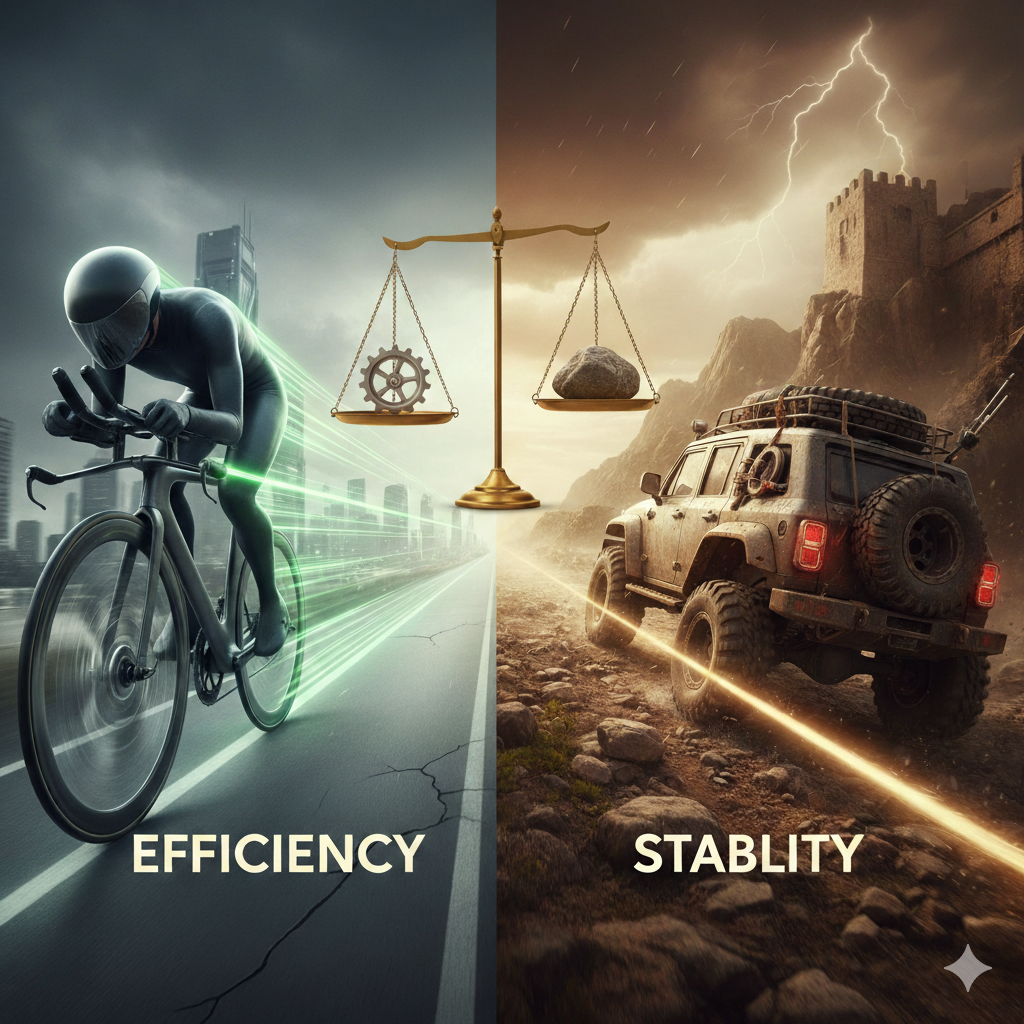
In many organizations, stability is considered the ultimate goal of IT operations. If systems are not crashing, servers are running, applications are accessible, and employees are not complaining loudly, leadership assumes everything is working as it should. Stability becomes the benchmark of success. However, stability and efficiency are not the same. A system can be stable and still waste time, money, and opportunity. It can function consistently while silently slowing growth. It can remain operational without delivering optimal performance. Stability ensures continuity. Efficiency drives progress. Confusing these two concepts leads organizations to settle for “good enough” technology environments that limit long-term competitiveness. This article explores why stability alone is insufficient and how efficiency transforms IT from a support function into a strategic growth engine.
1. Stability Preserves the Present; Efficiency Improves the Future
Stability focuses on maintaining operations without disruption. It ensures uptime, system availability, and predictable performance. This is essential. Without stability, business continuity collapses. But stability is reactive by nature. It aims to prevent breakdowns rather than enhance performance. It protects the present state of operations.
Efficiency, on the other hand, seeks improvement. It asks:
- Can this process be completed faster?
- Can this system consume fewer resources?
- Can automation reduce manual effort?
- Can response times improve customer satisfaction? An organization may proudly report 99.9% uptime, yet still require employees to spend hours manually generating reports. It may have zero outages, yet operate with outdated workflows that slow sales cycles. Stability keeps systems running. Efficiency ensures they run optimally. Businesses that focus only on avoiding failure may overlook opportunities to accelerate growth.
2. Stable Systems Can Still Contain Hidden Waste
Operational waste is often invisible in stable environments. Because systems function reliably, inefficiencies are tolerated.
Examples include:
- Employees switching between multiple applications to complete a single task
- Manual approval chains that delay decisions
- Redundant data entry across different systems
- Over-provisioned infrastructure consuming unnecessary costs
- Reports generated but rarely used
These inefficiencies do not cause system crashes. They simply consume time and resources quietly. Over time, small inefficiencies accumulate into significant operational drag. Teams remain busy but not productive. IT budgets increase without measurable improvement in output. Efficiency requires continuous evaluation of workflows, automation opportunities, and resource utilization. Stability alone does not eliminate waste.
3. Stability Without Optimization Limits Scalability
A stable IT environment may handle current workload effectively. However, when business demand increases, inefficiencies become amplified. For example, a manually managed process may work for 100 transactions per day. When volume increases to 1,000 transactions, the same process becomes unsustainable. Similarly, infrastructure that performs adequately under moderate traffic may struggle during growth phases. Without optimization, performance bottlenecks appear under pressure.
Efficiency prepares systems for scale. It involves:
- Performance tuning
- Workflow automation
- Resource allocation optimization
- Capacity planning
Stable systems that lack optimization often become obstacles during expansion. Growth exposes inefficiency. Organizations aiming for long-term scalability must move beyond maintenance and invest in continuous performance improvement.
4. Customer Experience Depends on Efficiency, Not Just Stability
Customers rarely notice stability they expect it. What they notice is speed, responsiveness, and convenience. A website that loads reliably but slowly is stable, yet inefficient. An order processing system that never crashes but takes days to confirm transactions is stable, yet inefficient. A support portal that functions but requires multiple manual interactions frustrates users. Customer expectations continue to rise. They compare experiences across industries, not just competitors. If digital processes are slow, complex, or repetitive, customers may shift to alternatives.
Efficiency enhances user experience through:
- Faster response times
- Streamlined workflows
- Simplified interactions
- Automated confirmations
- Real-time updates
Stability prevents dissatisfaction. Efficiency creates satisfaction. In competitive markets, satisfaction drives loyalty and revenue.
5. IT Teams Can Be Stable but Overloaded
An IT department may maintain stable systems while operating under constant pressure. Teams may spend most of their time resolving repetitive support tickets, applying patches, and monitoring systems. From a management perspective, stability suggests success. From an operational perspective, the team may be exhausted and unable to focus on innovation.
Efficiency improves internal workload balance by:
- Automating routine tasks
- Implementing self-service solutions
- Reducing repetitive incidents through root cause analysis
- Consolidating redundant systems
Without efficiency initiatives, IT teams remain reactive. They protect stability but cannot pursue strategic improvements. Over time, this imbalance reduces morale and slows digital transformation.
6. Financial Performance Reflects Efficiency, Not Just Reliability
Stable systems ensure operations continue. Efficient systems reduce cost per transaction, increase throughput, and enhance profitability.
For example:
- Automated invoicing reduces administrative expense.
- Optimized infrastructure lowers cloud spending.
- Streamlined onboarding accelerates revenue realization.
- Integrated analytics improve decision-making accuracy.
Organizations that measure only uptime miss deeper financial indicators such as cost efficiency, processing speed, and output per employee. Efficiency translates directly into measurable financial gains. Stability alone does not guarantee profitability improvement. A company can operate reliably yet remain uncompetitive due to excessive operational overhead.
7. Efficiency Requires Continuous Improvement Culture
Stability is often maintained through structured procedures and risk management. Efficiency, however, requires experimentation and change.
Continuous improvement involves:
- Regular performance audits
- Process mapping and redesign
- Benchmarking against industry standards
- Identifying automation opportunities
- Investing in employee training
Organizations focused solely on stability may resist change due to fear of disruption. However, controlled optimization does not compromise reliability. Instead, it strengthens resilience. A culture that values incremental improvement transforms IT into a proactive driver of business value.
8. Technology Evolution Demands Efficiency
Technology evolves rapidly. Systems that were efficient five years ago may now be outdated. New tools, frameworks, and automation platforms continuously redefine operational standards. Maintaining stability without modernization gradually reduces competitiveness. Legacy systems may remain stable but lack integration capabilities, advanced analytics, or automation features. As competitors adopt more efficient solutions, performance gaps widen. Efficiency requires periodic modernization. It demands evaluation of emerging technologies, cloud optimization strategies, and digital transformation initiatives. Stability protects the organization today. Efficiency prepares it for tomorrow.
9. Measuring the Right Metrics Matters
Organizations often track stability metrics such as:
- Uptime percentage
- Incident frequency
- Mean time to resolution
While important, these metrics do not measure efficiency.
Efficiency metrics include:
- Average process completion time
- Automation coverage percentage
- Cost per transaction
- Resource utilization rate
- Employee productivity indicators
Without measuring efficiency, organizations cannot improve it. Balanced performance management requires both reliability and optimization indicators.
10. Moving From Stable to Strategic
Transitioning from stability-focused IT to efficiency-driven IT involves structured steps:
- Conduct process audits to identify bottlenecks
- Eliminate redundant systems
- Implement automation for repetitive tasks
- Optimize infrastructure utilization
- Align IT goals with revenue and growth objectives
- Invest in employee upskilling
This shift does not abandon stability. It builds upon it. Stability forms the foundation. Efficiency builds competitive advantage.
Conclusion
Stability is essential. Without it, businesses cannot operate. However, stability alone is not a measure of excellence. A stable system can still be slow. It can still waste resources. It can still frustrate users. It can still limit growth. Efficiency transforms stability into strategic advantage. It reduces waste, accelerates processes, improves customer experience, and enhances financial performance. Organizations that equate stability with success risk stagnation. Those that pursue efficiency alongside reliability position themselves for sustainable growth. The goal is not merely to prevent failure. It is to enable progress. True IT maturity is achieved when systems are not only stable — but optimized, scalable, and continuously improving. Stability keeps the business running. Efficiency moves it forward.