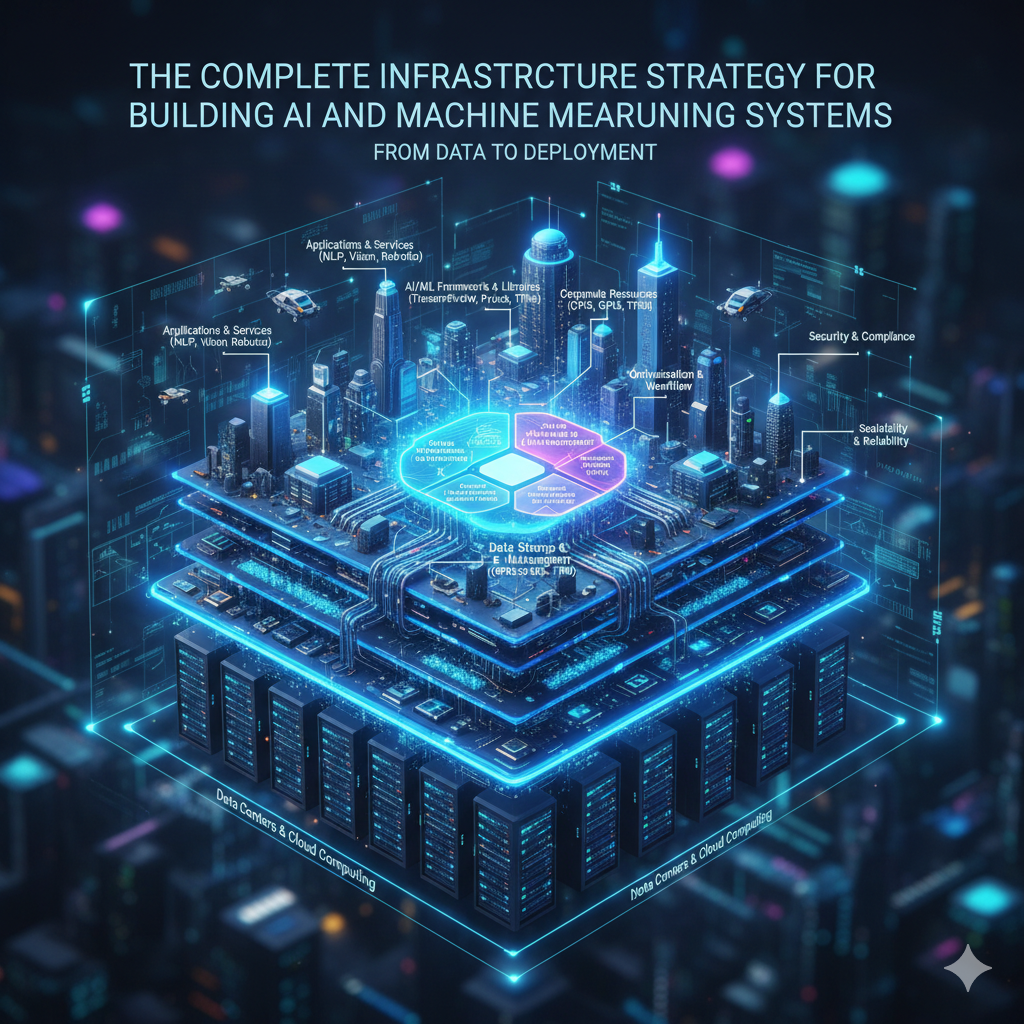
Building successful Artificial Intelligence (AI) and Machine Learning (ML) systems requires far more than selecting advanced algorithms or hiring skilled data scientists. The real backbone of any AI initiative is a carefully designed infrastructure strategy that supports data processing, model development, deployment, monitoring, scalability, and governance. Without a structured infrastructure foundation, even the most sophisticated models will struggle with performance issues, integration failures, and operational inefficiencies. Organizations that treat infrastructure as an afterthought often face delays, cost overruns, and underperforming systems. In contrast, those that prioritize infrastructure strategy from the beginning create a stable environment where AI innovation can thrive sustainably.
A complete AI infrastructure strategy begins with understanding that AI systems are fundamentally data-driven. The first layer of infrastructure must address data architecture. Data originates from multiple sources — transactional systems, CRM platforms, ERP systems, IoT devices, customer interactions, social media streams, and third-party APIs. Without a structured data ingestion framework, these sources remain fragmented and inconsistent. A strong infrastructure design consolidates structured and unstructured data into centralized repositories such as data lakes or data warehouses, ensuring accessibility, consistency, and scalability. Proper data architecture allows organizations to transform raw data into meaningful input for model training and analytics.
Equally important is data storage and management. AI models often require large volumes of historical data, which means storage systems must support high-capacity, cost-efficient, and secure retention. Organizations must decide between cloud infrastructure, on-premise systems, or hybrid models based on scalability, compliance, and operational needs. Cloud-based platforms provide elasticity, enabling businesses to scale resources up or down depending on computational demand. On-premise systems may be necessary for industries with strict regulatory requirements. A hybrid model combines flexibility with control. The decision must align with long-term AI adoption plans rather than short-term experimentation.
Another critical infrastructure component is computing power. Machine Learning workloads, especially deep learning models, demand high-performance processing capabilities. Graphics Processing Units (GPUs) and Tensor Processing Units (TPUs) significantly accelerate model training compared to traditional CPUs. Infrastructure planning must account for training environments, experimentation cycles, and real-time inference requirements. Underestimating computational needs leads to slow training cycles, delayed deployments, and inefficient resource utilization. A strategic investment in scalable computing resources ensures that performance bottlenecks do not hinder innovation.
Beyond storage and computing, data engineering pipelines form the operational backbone of AI systems. Raw data must be cleaned, transformed, standardized, and validated before model training begins. Automated ETL (Extract, Transform, Load) processes reduce manual effort and improve consistency. Infrastructure should include data validation checks, schema enforcement, and version control mechanisms to maintain reliability. Without robust data pipelines, models are exposed to inaccurate or inconsistent inputs, leading to unreliable predictions.
Model development environments also require careful infrastructure design. AI teams need secure and collaborative development workspaces, often built on notebook environments, version-controlled repositories, and containerized systems. Tools such as containerization platforms and orchestration frameworks enable reproducible experiments and seamless transitions from development to production. Reproducibility is critical in AI projects; models must be tested, audited, and retrained systematically. Infrastructure should support version control not only for code but also for datasets and trained models.
Deployment infrastructure is another major pillar in the AI lifecycle. Training a model is only half the challenge; integrating it into real-world applications is where infrastructure complexity intensifies. Organizations must decide whether models will operate in batch processing environments or deliver real-time inference. Real-time systems require low-latency architecture, API integration, and scalable microservices. Infrastructure must ensure uptime reliability, fault tolerance, and load balancing to handle varying traffic volumes. Deployment strategies such as continuous integration and continuous deployment (CI/CD) pipelines streamline updates and reduce downtime.
Monitoring and performance management are equally essential. AI systems are not static; they operate in dynamic environments where data patterns evolve. Infrastructure must include model monitoring systems that track accuracy, latency, drift, and bias over time. Model drift detection ensures that predictions remain reliable as market conditions change. Without continuous monitoring, models degrade silently, leading to inaccurate outputs and potential business losses. Logging systems, dashboards, and automated alerts provide transparency and accountability.
Security forms a non-negotiable component of AI infrastructure. AI systems often process sensitive customer data, financial records, and proprietary business information. Strong cybersecurity protocols, encryption standards, and access controls must be embedded into infrastructure architecture. Role-based access management ensures that only authorized personnel can modify models or datasets. Regular vulnerability assessments and compliance audits reduce exposure to data breaches and regulatory penalties. Infrastructure security is not simply a technical safeguard; it is a strategic necessity that protects trust and reputation.
Scalability planning is another cornerstone of a complete infrastructure strategy. Many AI initiatives begin with pilot projects but fail to scale effectively due to architectural limitations. Infrastructure must accommodate increasing data volumes, user demand, and model complexity without degrading performance. Cloud-native solutions and distributed computing frameworks enable horizontal scaling. Planning for scalability from the outset avoids costly system overhauls later.
Interoperability and integration are equally significant. AI systems rarely operate in isolation; they must connect with existing enterprise systems such as CRM platforms, supply chain systems, marketing automation tools, and analytics dashboards. Infrastructure should support API-driven integration and standardized communication protocols. Seamless integration ensures that AI outputs translate into actionable insights within operational workflows. Without integration, AI remains an isolated analytical exercise rather than a business-enabling tool.
Governance and compliance frameworks must also be embedded into infrastructure design. As regulations surrounding data privacy and AI transparency evolve, organizations must maintain audit trails and explainability mechanisms. Infrastructure should log model decisions, maintain training dataset records, and document parameter configurations. This level of documentation supports regulatory audits and builds stakeholder confidence. Governance infrastructure ensures that AI deployment aligns with ethical and legal standards.
Another essential component is cost optimization. AI infrastructure can become expensive if not managed strategically. Cloud environments, high-performance computing resources, and storage systems incur recurring expenses. Implementing resource monitoring tools helps track utilization and prevent unnecessary expenditure. Organizations must balance performance requirements with budget constraints through intelligent capacity planning and automated scaling policies. Cost transparency allows leadership to evaluate ROI accurately.
Disaster recovery and business continuity planning are frequently overlooked in AI infrastructure design. AI systems integrated into mission-critical operations must remain resilient during outages or cyber incidents. Infrastructure should include backup systems, failover mechanisms, and redundant storage solutions. Recovery time objectives (RTO) and recovery point objectives (RPO) must be clearly defined. Resilience planning ensures uninterrupted service delivery even under adverse conditions.
A mature AI infrastructure strategy also considers collaboration and workflow management. Cross-functional teams — including data scientists, engineers, analysts, and domain experts — require shared platforms for experimentation and communication. Centralized project management systems, shared repositories, and documentation frameworks streamline coordination. Collaborative infrastructure enhances productivity and reduces duplication of effort.
Automation plays a transformative role in AI infrastructure. Manual configuration of environments, deployment processes, and scaling operations increases the risk of human error. Infrastructure automation through scripts and orchestration tools standardizes processes and accelerates development cycles. Automated provisioning, model retraining schedules, and monitoring alerts contribute to operational efficiency. Automation reduces friction between experimentation and production readiness.
Ethical AI infrastructure is becoming increasingly important. Bias detection tools, fairness evaluation frameworks, and explainability dashboards must be embedded into model evaluation pipelines. Infrastructure should allow stakeholders to interpret model outputs transparently. Explainable AI systems foster accountability and trust, especially in industries such as finance, healthcare, and public services.
Performance optimization remains a continuous responsibility. AI systems require periodic tuning to maintain speed and efficiency. Infrastructure must support profiling tools that analyze latency and resource usage. Optimizing inference performance ensures smooth customer experiences and prevents service disruptions. Continuous improvement mechanisms maintain operational excellence.
Finally, a complete infrastructure strategy recognizes that AI is not a one-time deployment but an evolving capability. Market conditions shift, data sources expand, and technological advancements emerge. Infrastructure should be designed with adaptability in mind. Modular architecture, flexible APIs, and scalable storage systems allow organizations to incorporate new tools and frameworks without rebuilding entire systems. Future-proofing infrastructure reduces technical debt and supports long-term innovation.
In conclusion, building AI and Machine Learning systems demands a comprehensive infrastructure strategy encompassing data architecture, computing power, storage management, deployment frameworks, security protocols, governance mechanisms, monitoring systems, and scalability planning. Each component must align with business objectives, regulatory requirements, and growth expectations. Infrastructure is not merely a technical layer beneath AI; it is the foundation upon which intelligent systems operate reliably and efficiently. Organizations that invest in structured infrastructure strategy transform AI from experimental technology into operational advantage. Those that neglect infrastructure risk instability, inefficiency, and missed opportunities. A resilient, scalable, and secure infrastructure is the true engine driving successful AI transformation.