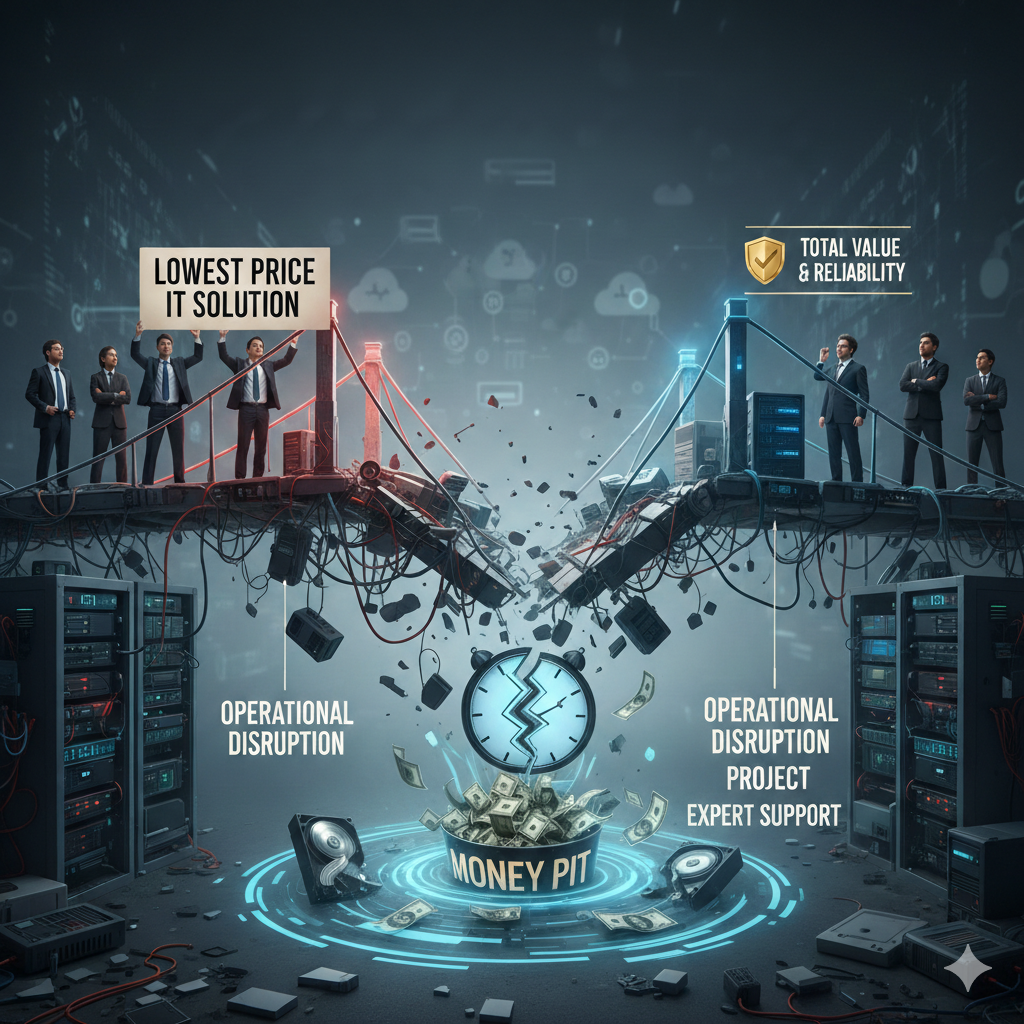
Cost control is a necessary discipline in every organization. Budgets matter. Margins matter. Efficiency matters. When evaluating IT vendors, software platforms, infrastructure upgrades, or managed services, price naturally becomes a key consideration. However, when price becomes the primary or only deciding factor, organizations expose themselves to risks that often outweigh the initial savings.
In technology decisions, the cheapest option is rarely the most economical in the long run. IT is not a one-time purchase. It is an operational foundation that supports revenue, data security, customer experience, compliance, and scalability. Choosing based solely on price may reduce upfront cost, but it can silently increase long-term expense, operational fragility, and strategic limitation.
1. The Short-Term Cost Trap
Selecting technology primarily based on lowest upfront cost often appears fiscally responsible. Budget constraints encourage leaders to prioritize immediate savings within the enterprise IT budgeting strategy. However, focusing solely on price neglects long-term value within the enterprise technology lifecycle. Lower-cost solutions may lack scalability, integration capability, or robust security controls. While initial investment appears minimal, hidden limitations within the enterprise software infrastructure surface over time. Organizations may find themselves replacing or heavily modifying the system earlier than anticipated, increasing total cost of ownership. Short-term savings achieved through price-driven decisions frequently generate long-term financial strain within the broader business technology ecosystem.
2. Hidden Costs of Limited Functionality
Inexpensive systems often provide basic functionality but lack advanced features within the workflow automation environment. As business complexity grows, gaps emerge. Organizations must purchase add-ons, invest in custom integrations, or implement manual workarounds. These supplementary expenses expand operational overhead inside the enterprise IT operations framework. What initially seemed economical evolves into fragmented infrastructure with higher maintenance requirements. Limited functionality also constrains innovation within the digital transformation strategy. The inability to scale or customize reduces adaptability in competitive markets.
3. Scalability Constraints and Growth Barriers
Low-cost IT solutions frequently struggle to support expansion. Restricted user capacity, limited data processing power, and minimal customization options hinder scalability within the enterprise infrastructure architecture. As transaction volumes increase, performance declines. Businesses may encounter sudden system upgrades or migration needs that disrupt continuity. Investing in scalable cloud computing infrastructure from the outset often prevents these disruptions. Price-based decisions ignore future growth requirements within the enterprise technology investment strategy, creating structural limitations.
4. Security Compromises and Risk Exposure
Budget solutions may lack advanced controls within the enterprise cybersecurity ecosystem. Limited encryption standards, basic access management, and infrequent patch updates expose organizations to elevated risk. Security breaches can result in regulatory penalties, reputational damage, and operational downtime. The financial consequences far exceed initial savings. Comprehensive network security architecture should be evaluated based on robustness rather than price alone. Risk exposure within the digital risk management framework increases when security is treated as optional rather than foundational.
5. Integration Limitations and Data Silos
Affordable systems may not integrate seamlessly with existing platforms. Weak compatibility within the enterprise application ecosystem leads to data silos and duplicated workflows. Fragmentation complicates reporting inside the enterprise business intelligence framework. Leadership may struggle to access unified performance metrics. Over time, integration constraints weaken operational visibility. Technology should strengthen cohesion within the enterprise architecture strategy alignment, not fragment it.
6. Increased Maintenance and Support Costs
Low-cost vendors may offer limited support services within the enterprise IT management infrastructure. Slow response times and minimal customization assistance create operational delays. Internal teams must compensate for vendor shortcomings, increasing workload and diverting attention from strategic initiatives. Maintenance complexity inside the enterprise infrastructure lifecycle grows as patches and fixes accumulate. The hidden labour cost associated with insufficient support erodes the perceived savings of lower upfront pricing.
7. Impact on Employee Productivity
When tools lack intuitive design or advanced features within the digital productivity ecosystem, employees adapt through manual processes. This reduces efficiency and increases error rates. Over time, reliance on limited systems lowers morale and diminishes output. High-performing teams require modern solutions aligned with evolving operational demands inside the enterprise workflow management framework. Productivity losses compound silently, affecting financial performance across departments.
8. Opportunity Cost of Underinvestment
Choosing IT based solely on price restricts innovation potential. Advanced analytics, automation, and artificial intelligence capabilities embedded in robust enterprise technology platforms drive growth. Underinvestment prevents exploration of new revenue models and efficiency improvements within the digital innovation strategy. Competitors leveraging superior systems gain advantage. Opportunity cost often surpasses the difference in initial purchase price within the broader enterprise growth framework.
9. Reputation and Customer Experience Risks
Outdated or limited systems affect customer-facing operations within the digital customer engagement infrastructure. Slow response times, inconsistent communication, and service disruptions damage trust. Customers increasingly expect seamless digital experiences supported by reliable customer relationship management systems. Compromising quality to reduce cost undermines brand reputation. Technology decisions should protect long-term perception within the enterprise brand strategy, not just short-term budgets.
10. Value-Driven IT Investment Strategy
Effective IT decisions balance cost with scalability, security, integration, and long-term return. Organizations should evaluate total cost of ownership within the enterprise technology lifecycle management framework, not just purchase price. Structured assessments of enterprise architecture alignment, vendor reliability, and future growth compatibility ensure sustainable investment. Technology should enable resilience and innovation within the business technology ecosystem. Choosing IT based solely on price often sacrifices stability and growth. A value-driven approach strengthens competitiveness, operational efficiency, and strategic agility within the evolving enterprise IT landscape.