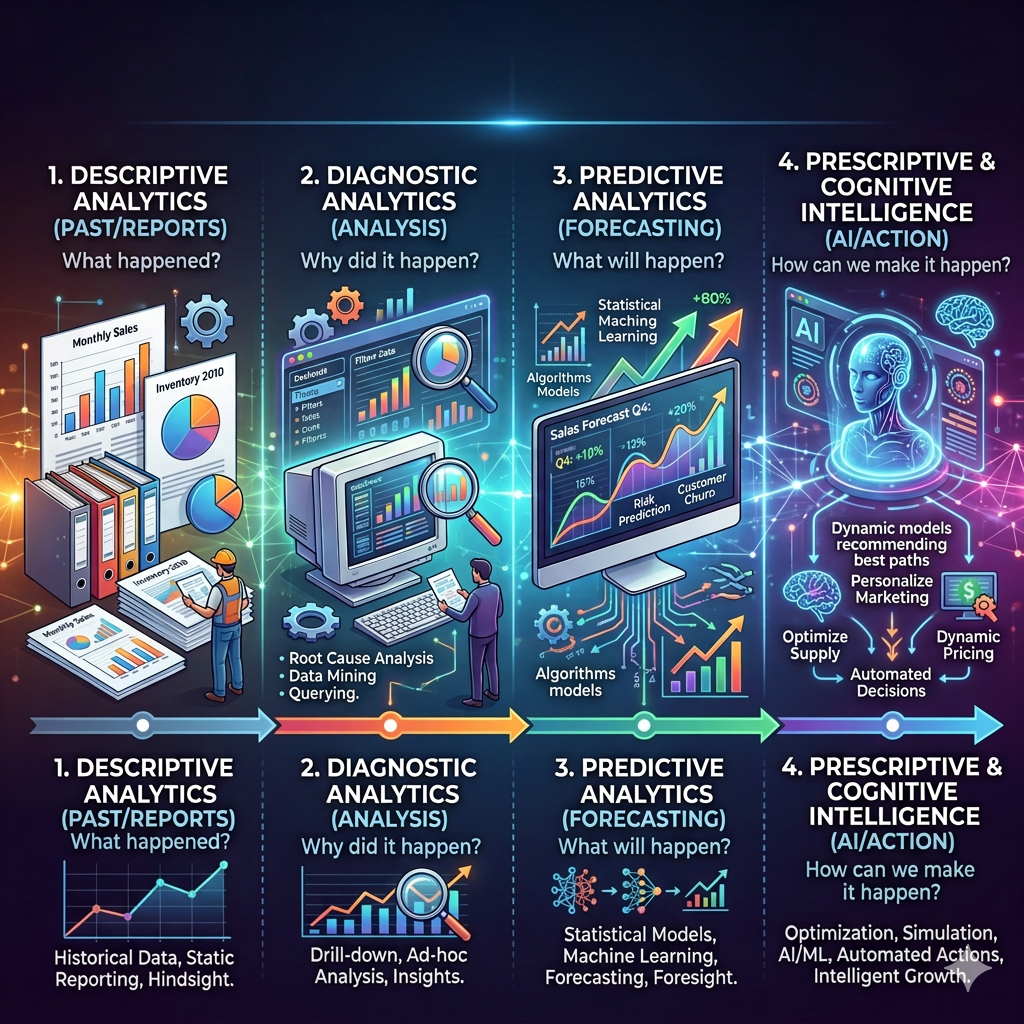
In the modern business environment, the role of analytics has undergone a significant transformation. What once began as simple reporting has evolved into a sophisticated system capable of forecasting future outcomes and guiding strategic decisions. Organizations no longer rely solely on historical summaries; instead, they leverage advanced techniques to anticipate trends, reduce uncertainty, and gain competitive advantage. Understanding the evolution of analytics: from reports to predictive intelligence reveals how businesses have moved from passive observation to proactive decision-making.
In its earliest form, analytics was primarily focused on descriptive reporting. Businesses collected data from their operations and summarized it into reports that described what had already happened. These reports included sales figures, financial statements, inventory levels, and basic performance metrics. While this information was useful for tracking performance, it had clear limitations. Descriptive analytics answered questions like “What happened?” but did not explain why it happened or what should be done next.
At this stage, decision-making remained largely reactive. Managers reviewed reports periodically and responded to issues after they had already occurred. For example, if sales declined, leaders would analyze past data to identify possible reasons. However, by the time the problem was recognized, the opportunity to prevent it had often passed.
As businesses began to recognize the limitations of basic reporting, the next stage in the evolution of analytics emerged: diagnostic analytics. This approach focused on understanding the causes behind observed outcomes. Instead of simply presenting data, diagnostic analytics explored relationships between variables to explain why certain patterns occurred.
For instance, a decline in sales could be linked to reduced marketing activity, changes in pricing, or shifts in customer behavior. By identifying these connections, organizations gained deeper insights into their operations. Diagnostic analytics provided a more detailed understanding of performance, allowing businesses to address underlying issues rather than just reacting to surface-level symptoms.
The advancement of technology played a critical role in enabling this shift. Improved data storage, faster processing capabilities, and more sophisticated analytical tools allowed organizations to handle larger and more complex datasets. As a result, businesses could analyze multiple variables simultaneously and uncover patterns that were previously difficult to detect.
The next major development in the evolution of analytics was the introduction of predictive analytics. Unlike descriptive and diagnostic approaches, predictive analytics focuses on estimating future outcomes based on historical data and statistical models. This shift marked a fundamental change in how organizations used data.
Instead of asking only “What happened?” or “Why did it happen?”, businesses began asking “What is likely to happen next?” Predictive analytics uses techniques such as regression analysis, machine learning algorithms, and pattern recognition to forecast trends and identify potential risks.
For example, companies can predict customer churn by analyzing past behavior, estimate future demand based on seasonal patterns, or forecast financial performance using historical data. These insights allow organizations to prepare for future scenarios rather than reacting after the fact.
The transition to predictive analytics also introduced a more proactive approach to decision-making. Businesses could identify potential problems early and take preventive actions. For instance, if a predictive model indicates a high probability of customer churn, organizations can implement retention strategies before customers leave.
Another important aspect of this evolution is the integration of real-time analytics. In earlier stages, reports were often generated periodically, such as daily, weekly, or monthly. While useful, these reports could not capture rapid changes in dynamic environments. Real-time analytics enables organizations to monitor data continuously and respond immediately to emerging trends.
For example, e-commerce platforms can track user behavior in real time, allowing them to adjust recommendations or promotions instantly. Similarly, financial institutions can detect unusual transactions as they occur, reducing the risk of fraud.
As analytics capabilities advanced further, organizations began combining predictive techniques with automation and artificial intelligence, leading to the development of predictive intelligence. This stage represents a more advanced form of analytics where systems not only forecast outcomes but also provide actionable recommendations.
Predictive intelligence integrates data analysis with machine learning models that continuously improve as new data becomes available. These systems can identify complex patterns, adapt to changing conditions, and generate insights that support strategic decisions.
For instance, predictive intelligence can optimize pricing strategies by analyzing market demand, competitor behavior, and customer preferences simultaneously. It can also enhance supply chain management by forecasting disruptions and suggesting alternative solutions.
Another key feature of predictive intelligence is its ability to handle large and diverse datasets. Modern businesses generate data from multiple sources, including digital platforms, customer interactions, operational systems, and external environments. Predictive intelligence systems integrate these data sources to create a comprehensive view of business activities.
This integration allows organizations to uncover relationships between different aspects of their operations. For example, marketing data can be linked with sales outcomes, and operational metrics can be connected to customer satisfaction levels. These insights provide a more holistic understanding of how various factors influence performance.
Despite these advancements, the evolution of analytics also introduces new challenges. One of the most significant challenges is data quality and governance. As analytics becomes more complex, the accuracy of insights depends heavily on the reliability of underlying data. Inconsistent or incomplete data can lead to incorrect predictions and poor decision-making.
Another challenge involves the interpretation of analytical results. While predictive models can generate forecasts, understanding their implications requires human expertise. Decision-makers must evaluate these insights within the broader context of business strategy and market conditions.
The adoption of predictive intelligence also requires cultural changes within organizations. Businesses must move from a mindset focused on reporting past performance to one that values forward-looking insights. This shift involves training employees, investing in analytical capabilities, and integrating data-driven thinking into everyday decision-making processes.
Ethical considerations also become more important as analytics evolves. Predictive models often rely on large datasets that may include sensitive information. Organizations must ensure that data is used responsibly and that privacy and security standards are maintained.
Ultimately, the evolution of analytics: from reports to predictive intelligence reflects a broader transformation in how businesses approach decision-making. What began as a tool for summarizing past performance has become a strategic asset for anticipating the future.
Organizations that embrace this evolution gain a significant advantage. They are better equipped to identify opportunities, manage risks, and respond to changes in their environment. By moving beyond descriptive reporting and adopting predictive intelligence, businesses can transform data into a powerful driver of innovation and growth.
In a world where information is abundant and competition is intense, the ability to anticipate future outcomes is no longer optional. It is a critical capability that defines the success of modern organizations. Through continuous advancement and thoughtful implementation, analytics continues to reshape the way businesses operate, making it an essential component of strategic decision-making.