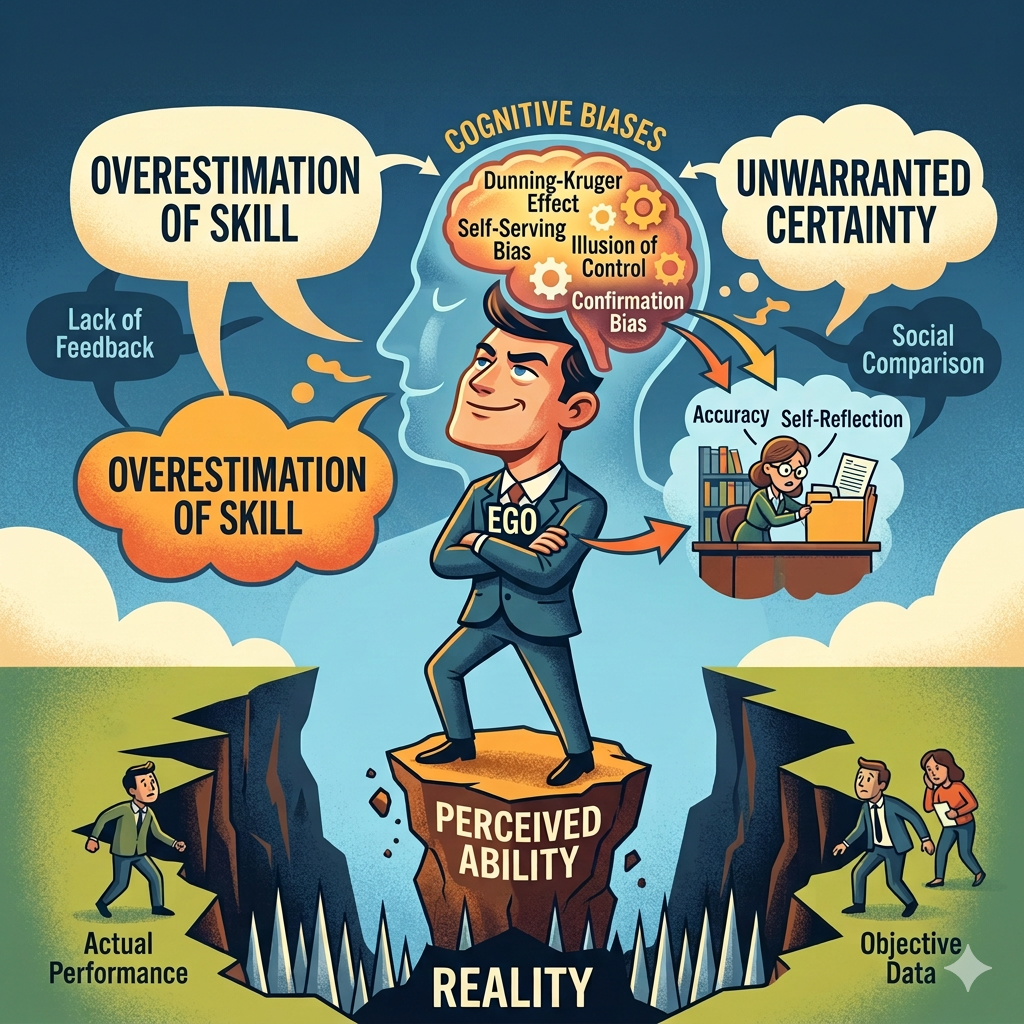
Confidence is often considered a valuable trait in leadership, decision-making, and personal development. People who appear confident are usually perceived as capable, knowledgeable, and trustworthy. In many professional environments, confidence is even associated with competence and authority. However, there is a critical distinction between healthy confidence and overconfidence. While confidence can motivate action and encourage innovation, overconfidence occurs when individuals believe their knowledge, abilities, or predictions are more accurate than they actually are. Understanding the psychology behind overconfidence reveals why intelligent and experienced individuals can still make highly confident yet incorrect decisions.
At its core, overconfidence arises from the way the human brain processes information and evaluates its own abilities. People do not always assess their knowledge objectively. Instead, they rely on mental shortcuts and subjective impressions when judging how much they understand. These shortcuts help individuals make quick judgments in everyday situations, but they can also create systematic errors in self-evaluation.
One well-known psychological explanation for this tendency is the Dunning–Kruger effect. This cognitive bias describes how individuals with limited knowledge or skill in a particular area may overestimate their competence. Because they lack the expertise required to fully understand a subject, they also lack the ability to accurately evaluate their own performance. As a result, they may believe they are more capable than they actually are. Interestingly, this bias does not imply that intelligent people are immune to overconfidence. Even highly educated individuals may display excessive confidence when operating outside their areas of expertise.
Another key factor in overconfidence is the illusion of knowledge. In modern society, information is widely accessible through technology, media, and communication networks. People often feel that they understand complex subjects simply because they have encountered simplified explanations or summaries. However, familiarity with information is not the same as deep understanding. When individuals encounter concepts repeatedly, they may begin to feel confident about their comprehension even if their knowledge remains superficial.
A related phenomenon is known as the illusion of explanatory depth. Many people believe they understand how systems work until they attempt to explain them in detail. When asked to describe complex mechanisms—such as economic systems, technological processes, or organizational strategies—individuals frequently realize that their understanding lacks depth. The gap between perceived knowledge and actual understanding contributes significantly to overconfidence.
Past experiences also influence perceptions of competence. When individuals experience success, they often attribute positive outcomes to their own skills or decisions. While personal ability may indeed contribute to success, outcomes are frequently shaped by multiple factors such as timing, external conditions, and chance. When success is attributed solely to personal skill, individuals may become increasingly confident in their judgment, even when their success involved favorable circumstances beyond their control.
Another contributor to overconfidence is confirmation bias, the tendency to notice information that supports existing beliefs while ignoring evidence that contradicts them. When individuals are confident in their views, they may selectively interpret new information in ways that reinforce their existing assumptions. Over time, this selective interpretation strengthens the belief that their perspective is correct.
Social dynamics can also reinforce overconfidence. In many professional and social environments, people are rewarded for appearing decisive and self-assured. Leaders who communicate ideas with strong conviction are often perceived as more credible, even when their certainty is not fully supported by evidence. Because confidence is associated with leadership qualities, individuals may feel pressure to express certainty even when they are unsure.
Organizational culture can further amplify this tendency. When employees believe that expressing doubt may be interpreted as weakness, they may avoid questioning assumptions or admitting uncertainty. As a result, confident opinions may dominate discussions, while more cautious perspectives remain unspoken.
The media environment also contributes to the psychology of overconfidence. Public discussions often favor simple and definitive explanations for complex issues. Experts and commentators who present clear conclusions may attract more attention than those who acknowledge uncertainty or nuance. This preference for clear answers can encourage individuals to adopt stronger confidence in their views.
Another important factor is the human tendency to rely on mental models—simplified representations of how the world works. These models help people understand complex systems and make decisions quickly. However, mental models are always incomplete. When individuals become overly attached to a particular model, they may underestimate the complexity of real-world situations.
In business and organizational contexts, overconfidence can significantly influence strategic decisions. Leaders who are overly confident in their forecasts may underestimate risks, overestimate market demand, or assume that previous success will continue indefinitely. This can lead to aggressive expansion strategies, unrealistic financial projections, or insufficient contingency planning.
Financial markets provide numerous examples of overconfidence. Investors often believe they can predict market movements more accurately than others, leading to excessive trading or risky investment strategies. In many cases, this confidence is based on recent successes rather than consistent evidence of predictive ability.
However, it is important to recognize that confidence itself is not inherently negative. Confidence encourages individuals to pursue opportunities, take initiative, and make decisions under uncertainty. Without some degree of confidence, innovation and progress would be difficult to achieve.
The challenge arises when confidence exceeds evidence. When individuals become overly certain about their judgments, they may stop seeking additional information or alternative perspectives. This reduces the ability to detect errors and adjust strategies when circumstances change.
Several approaches can help individuals and organizations manage the risks associated with overconfidence. One effective strategy is encouraging evidence-based decision-making. By grounding decisions in data, research, and systematic analysis, organizations can reduce reliance on subjective judgments.
Another helpful practice is structured debate and peer review. When teams encourage open discussion and critical questioning, assumptions can be tested more rigorously. Diverse perspectives increase the likelihood that potential flaws in reasoning will be identified.
Regular reflection and learning also play an important role. Reviewing past decisions allows individuals to examine whether their predictions were accurate and identify where overconfidence may have influenced judgment. Over time, this process helps improve calibration between confidence and actual knowledge.
Developing intellectual humility is another powerful safeguard. Intellectual humility involves recognizing the limits of one’s knowledge and remaining open to new evidence. It does not require abandoning confidence but encourages individuals to balance certainty with curiosity.
Organizations that value learning over status are more likely to maintain this balance. When leaders openly acknowledge uncertainty and encourage exploration of alternative viewpoints, teams become more comfortable discussing complex issues honestly.
Ultimately, the psychology behind overconfidence reflects the brain’s natural tendency to simplify complexity and maintain positive self-perception. These tendencies can be beneficial when they support motivation and initiative, but they can also create blind spots when individuals assume they know more than they actually do.
Recognizing the mechanisms behind overconfidence allows individuals to manage it more effectively. By combining confidence with careful analysis, curiosity, and openness to feedback, people can make decisions that are both decisive and well-informed. In this way, understanding the psychology of overconfidence becomes a valuable step toward better thinking, stronger leadership, and more accurate decision-making.