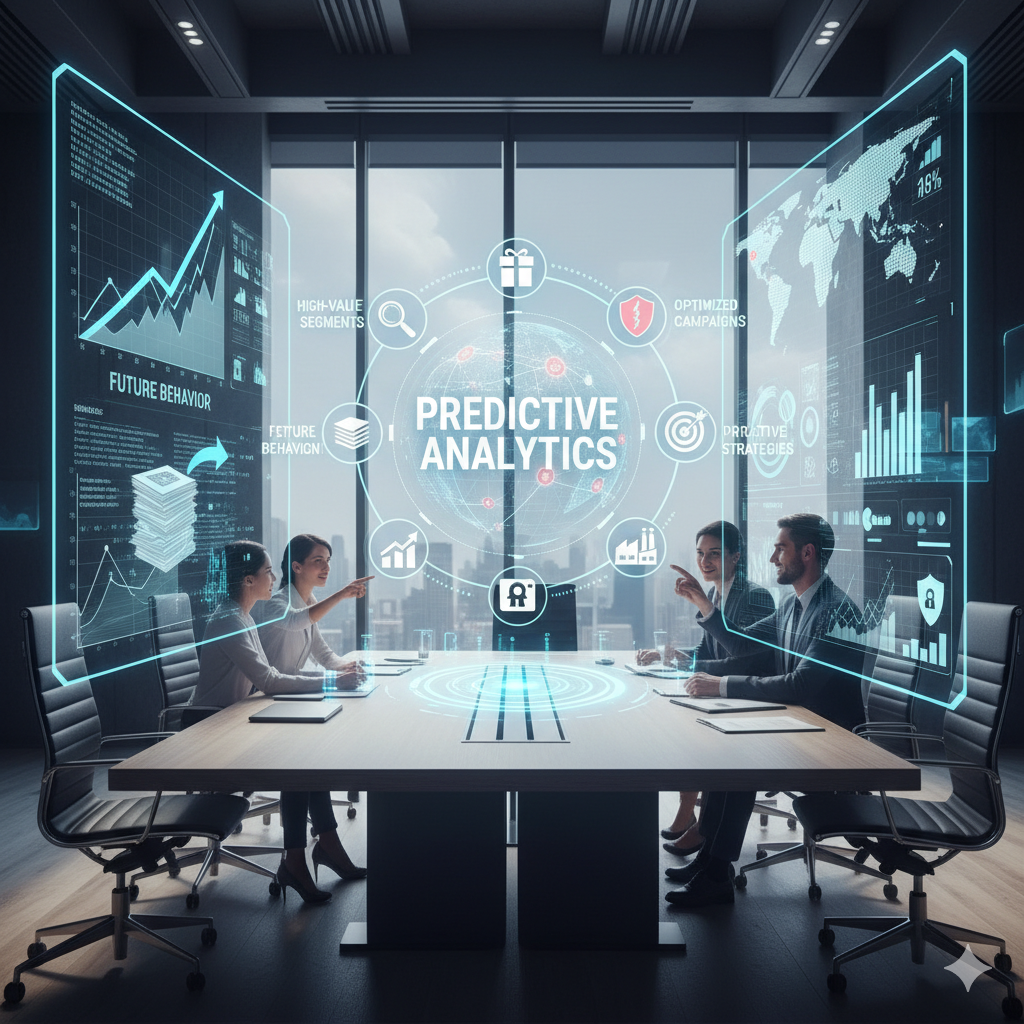
Marketing has evolved from intuition-driven campaigns to precision oriented strategy powered by data analytics. In earlier decades, marketing decisions were guided primarily by experience, creative instinct, and broad demographic assumptions. While those elements still matter, modern competition demands greater accuracy and accountability. Businesses can no longer rely solely on historical reports to understand what happened in the past. They must anticipate what will happen next. This shift has elevated the importance of predictive analytics, a discipline that uses historical data, statistical models, and machine learning algorithms to forecast future outcomes. In modern marketing, predictive analytics is not a luxury it is a strategic necessity.
At its core, predictive analytics transforms raw data into forward-looking insight. Instead of merely analysing past campaign performance, it identifies patterns that indicate future customer behaviour. By examining purchase histories, browsing activity, engagement metrics, and demographic variables, predictive models estimate the likelihood of conversion, churn, or repeat purchase. This proactive capability changes the role of marketing from reactive execution to strategic anticipation.
One of the most impactful applications of predictive analytics in marketing is customer segmentation. Traditional segmentation relied on basic categories such as age, location, or income. While useful, these categories often oversimplified behaviour. Predictive models go deeper by grouping customers based on purchasing probability, response likelihood, and lifetime value potential. This refined segmentation allows marketers to tailor messaging and allocate budgets more efficiently. Rather than targeting broad audiences, businesses focus resources on high-probability segments, increasing efficiency and return on investment.
Another major contribution lies in improving lead scoring. In many organizations, sales teams struggle with large volumes of leads of varying quality. Predictive analytics assigns scores based on behavioural signals and historical conversion data, identifying which prospects are most likely to convert. This prioritization enhances sales productivity and shortens the sales cycle. Instead of treating all leads equally, marketing and sales teams concentrate efforts where impact is highest.
Personalization has become a defining characteristic of modern marketing, and predictive analytics powers this transformation. By analysing user behaviour, predictive systems recommend products, content, and offers tailored to individual preferences. E-commerce platforms use these models to display relevant items based on browsing patterns. Email campaigns adapt content dynamically depending on predicted engagement likelihood. This level of personalization strengthens customer experience, increasing satisfaction and loyalty.
Predictive analytics also enhances customer retention strategies. Acquiring new customers is often more expensive than retaining existing ones. Predictive models identify early warning signs of churn by analysing declining engagement, purchase frequency changes, or service complaints. With this insight, businesses can intervene proactively through targeted offers, personalized communication, or loyalty incentives. Preventing churn protects revenue and improves long-term profitability.
Pricing optimization is another area where predictive analytics delivers measurable value. By analysing historical sales data, seasonal patterns, competitor pricing, and customer responsiveness, businesses estimate price elasticity. This enables dynamic pricing strategies that balance demand stimulation with margin protection. Instead of applying blanket discounts, organizations implement data-informed pricing adjustments that maximize both sales volume and profitability.
Marketing budget allocation benefits significantly from predictive modelling. Traditional budget planning often relies on past performance averages. Predictive analytics evaluates channel performance trends and forecasts expected returns under different investment scenarios. This scenario modelling helps decision-makers allocate resources toward high-performing channels while minimizing waste in underperforming areas. The result is more strategic spending and improved marketing ROI.
Campaign optimization becomes more precise with predictive insights. Instead of launching a campaign and analysing results afterward, marketers use predictive models to test variations in advance. Simulations estimate which creative elements, audience segments, or timing strategies are likely to generate stronger responses. This reduces trial-and-error experimentation and accelerates performance improvement.
Another critical role of predictive analytics involves customer lifetime value (CLV) forecasting. Understanding the long-term revenue potential of each customer guides acquisition and retention strategies. If predictive models indicate that certain segments generate higher lifetime value, businesses can justify higher acquisition costs for those segments. This alignment between CAC and CLV strengthens financial sustainability.
Content strategy also benefits from predictive capabilities. By analysing engagement patterns, businesses identify topics, formats, and channels that resonate with specific audiences. Predictive tools forecast content performance based on historical trends. This insight helps marketing teams create materials with higher relevance and engagement potential, reducing content waste.
The integration of artificial intelligence (AI) further amplifies predictive analytics capabilities. Machine learning algorithms continuously refine models as new data becomes available. This dynamic adaptation ensures that predictions remain relevant in rapidly changing markets. AI-driven analytics can process vast datasets far beyond human analytical capacity, uncovering subtle correlations and emerging trends.
However, the power of predictive analytics depends on data quality. Incomplete, inconsistent, or biased datasets produce unreliable forecasts. Effective data governance practices are essential to maintain accuracy and integrity. Organizations must invest in clean data collection, standardized tracking processes, and cross-system integration to ensure meaningful predictions.
Ethical considerations also play a role. Predictive analytics involves analysing customer behaviour at granular levels. Responsible use requires transparency, consent, and compliance with privacy regulations. Trust is foundational to long-term relationships, and misuse of data can damage brand reputation. Balancing predictive precision with ethical responsibility safeguards sustainable growth.
Another advantage of predictive analytics is its role in demand forecasting. Retailers, for example, use predictive models to anticipate seasonal trends and adjust inventory levels accordingly. Accurate demand forecasts reduce overstocking and stockouts, improving operational efficiency and customer satisfaction. Marketing campaigns aligned with forecasted demand maximize impact.
In competitive environments, speed and agility determine success. Predictive analytics equips organizations with foresight, enabling them to anticipate market shifts before competitors react. Early identification of emerging preferences or declining interest provides strategic advantage. Instead of responding to trends after they peak, businesses can position themselves proactively.
Collaboration between marketing, sales, and analytics teams is crucial for maximizing predictive impact. Analysts translate data patterns into actionable insights, marketers design campaigns based on these insights, and sales teams execute with prioritized leads. This cross-functional alignment ensures that predictive intelligence drives tangible outcomes.
Despite its advantages, predictive analytics is not infallible. Models rely on historical data, which may not fully capture unprecedented events or sudden disruptions. Therefore, predictive insights should complement, not replace, strategic judgment. Human expertise remains essential for interpreting predictions within broader market contexts.
Ultimately, predictive analytics reshapes modern marketing from reactive analysis to proactive strategy. It shifts focus from reporting what happened to forecasting what will happen. This transformation enhances efficiency, improves personalization, strengthens retention, and optimizes profitability.
In conclusion, the role of predictive analytics in modern marketing extends far beyond advanced reporting. It empowers organizations to anticipate behaviour, allocate resources strategically, and create personalized experiences at scale. By integrating data-driven foresight with strategic execution, businesses gain measurable competitive advantage. In a landscape defined by rapid change and high competition, predictive analytics is not merely an analytical tool it is a cornerstone of sustainable marketing success.