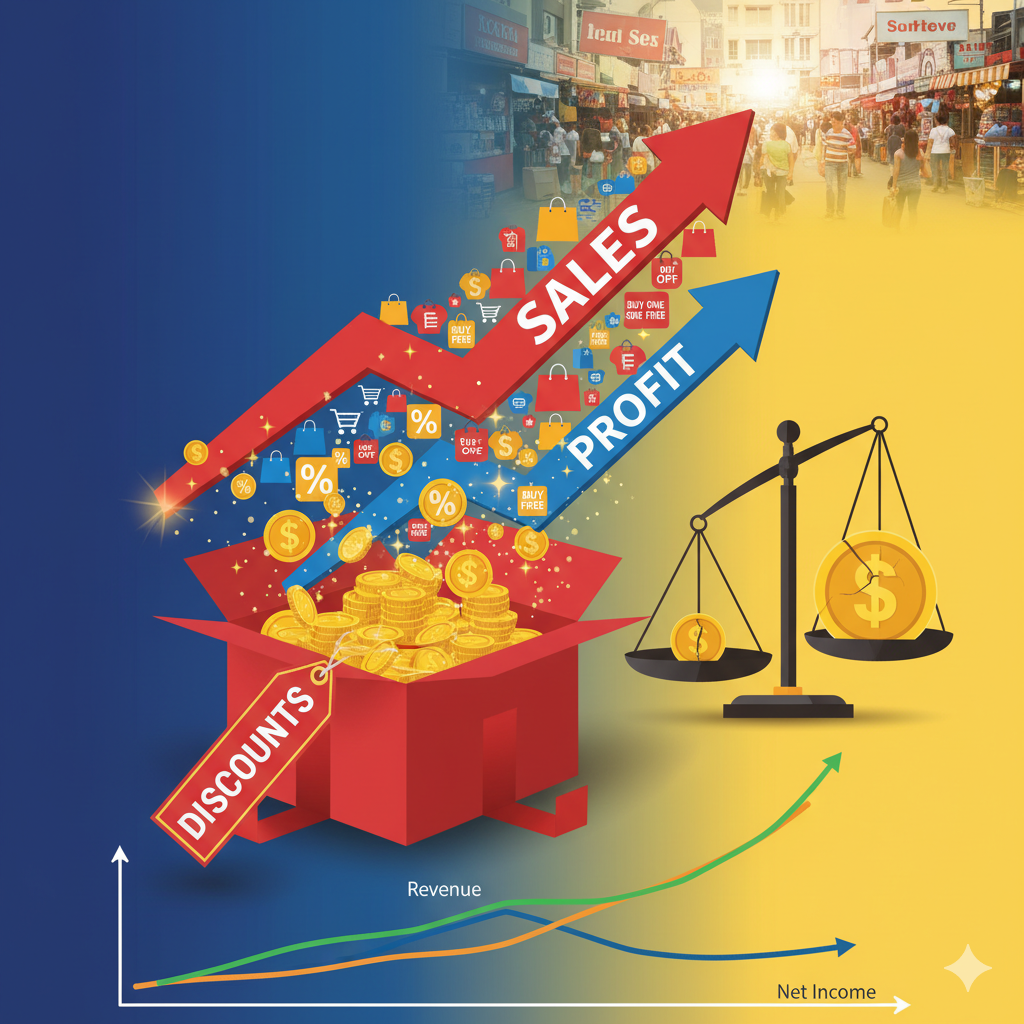
Discounts are among the most commonly used tools in modern business strategy. They are quick to implement, easy to communicate, and often produce immediate results. A price reduction can trigger urgency, attract attention, and boost short-term demand almost instantly. Sales graphs rise, order volumes increase, and marketing campaigns appear successful. However, beneath this visible growth lies a more complex reality. While discounts can increase sales volume, they often reduce profit margins, weaken brand positioning, and create long-term financial instability. The challenge for businesses is not whether discounts work they clearly do but whether they work in a way that sustains profitability.
At first glance, discounting seems like a logical strategy. Lowering prices reduces the barrier to purchase, making products more accessible to price-sensitive customers. In competitive markets, especially where multiple brands offer similar products, discounts can serve as a differentiator. When competitors reduce prices, businesses may feel compelled to respond in order to protect market share. The short-term boost in revenue reinforces the belief that the strategy is effective. Yet revenue alone does not determine financial health. Profitability depends on the relationship between selling price, cost structure, and operating expenses. When discounts shrink margins faster than they increase volume, the overall impact can be negative.
The core issue lies in margin compression. Every product or service has a cost base production, logistics, marketing, salaries, overhead, and distribution. When a company reduces its selling price without reducing its underlying costs, the profit per unit declines. To compensate for the lower margin, the company must sell significantly more units. In many cases, the increase in sales volume is insufficient to offset the reduction in margin. Businesses celebrate higher sales numbers without realizing that their net profit has declined. This illusion of growth can mask underlying financial strain.
Another risk associated with frequent discounting is the shift in customer perception. Pricing communicates value. When products are consistently offered at reduced prices, customers begin to question their original worth. Over time, buyers may delay purchases in anticipation of future promotions. This behaviour trains the market to expect lower prices, making it difficult for businesses to return to standard pricing without experiencing a drop in demand. What initially appears as a strategic incentive gradually becomes a dependency. The brand transitions from being value-driven to being price-driven.
The psychological impact of discounting on consumer behaviour further complicates the issue. Discounts create a sense of urgency and excitement, particularly when framed as limited-time offers. However, repeated promotions erode this urgency. When discounts become predictable, they lose their persuasive power. Customers learn that waiting leads to better deals. As a result, full-price sales decline, and the company becomes reliant on continuous promotions to maintain volume. This cycle reduces pricing power, which is one of the most critical drivers of long-term profitability.
Operational costs can also increase during heavy discount campaigns. Higher sales volumes may require additional staffing, expanded logistics capacity, and increased customer service support. Marketing expenses often rise to promote the discount effectively. If these incremental costs are not carefully managed, they further reduce the overall profitability of the campaign. In some cases, businesses underestimate the indirect expenses associated with discount-driven growth, leading to inaccurate assessments of financial performance.
Discount strategies also affect competitive dynamics. When one company lowers prices, competitors may respond with similar or even deeper discounts. This creates a price war, where businesses compete primarily on cost rather than value. In such scenarios, margins shrink across the entire industry. Larger organizations with stronger financial reserves may survive prolonged discount battles, while smaller businesses struggle to maintain cash flow. Engaging in aggressive price competition without a clear differentiation strategy can weaken market positioning over time.
Another overlooked consequence is the impact on customer lifetime value (CLV). Customers acquired through heavy discounts often display lower brand loyalty. They are motivated primarily by price rather than product experience or brand alignment. When another company offers a better deal, they switch easily. This transactional relationship reduces repeat purchase rates and limits long-term revenue potential. In contrast, customers who purchase at full price based on perceived value are more likely to remain loyal and generate consistent revenue streams.
Discounting can also distort performance analysis. When sales increase during promotional periods, it becomes difficult to distinguish between genuine demand growth and temporary price-driven spikes. Businesses may misinterpret promotional success as sustainable market expansion. Once the discount period ends, sales often decline sharply, revealing that demand was artificially stimulated. Without careful analysis of incremental sales impact, companies risk overestimating the effectiveness of their strategy.
In certain industries, such as retail and e-commerce, seasonal promotions are expected and strategically planned. When executed with discipline, limited-time discounts can clear excess inventory, attract new customers, or introduce new products. The key lies in maintaining balance. Strategic discounting must align with broader profitability objectives, not replace them. Successful organizations define clear thresholds such as minimum acceptable margins and maximum promotional frequency to prevent long-term erosion of value.
Technology and data analytics play an important role in managing discount strategies effectively. By analysing purchasing patterns, customer segments, and price elasticity, businesses can identify where discounts generate incremental profit rather than merely shifting demand. Targeted promotions directed at specific customer groups often produce better results than blanket price reductions. Personalization allows companies to protect margins while still incentivizing purchases.
Another strategic consideration involves differentiating between revenue growth and profit growth. Revenue represents total income generated, while profit reflects what remains after expenses. Businesses that prioritize top-line expansion without monitoring bottom-line impact may unintentionally weaken financial stability. Sustainable growth requires balancing both metrics. A discount campaign that increases revenue but reduces overall profitability ultimately undermines long-term success.
Brand positioning is equally critical. Premium brands rarely rely heavily on discounts because exclusivity and perceived quality form the core of their value proposition. Excessive promotions can dilute brand equity and reduce customer trust. Maintaining consistent pricing reinforces the perception of reliability and quality. For value-oriented brands, discounts may align more naturally with positioning, but even then, disciplined management is essential.
Economic conditions often influence discount strategies. During downturns, businesses may reduce prices to stimulate demand. While this can protect short-term cash flow, repeated reliance on price reductions during challenging periods may weaken recovery potential. Instead of defaulting to discounts, companies can explore alternative strategies such as bundling products, enhancing service value, or introducing loyalty programs that reward repeat purchases without permanently reducing price levels.
Internal decision-making processes also affect discount outcomes. When marketing teams focus primarily on boosting campaign metrics, they may advocate aggressive promotions. Finance departments, however, prioritize margin preservation. Effective leadership requires cross-functional collaboration to ensure that promotional strategies align with overall business objectives. Transparent communication and shared performance indicators prevent misalignment between departments.
One of the most effective alternatives to blanket discounting is emphasizing value creation rather than price reduction. Improving product quality, enhancing customer experience, and offering differentiated services strengthen competitive positioning without sacrificing margins. When customers perceive strong value, they become less sensitive to price fluctuations. Investment in brand storytelling, service excellence, and innovation often produces more sustainable growth than repeated discounts.
Ultimately, the relationship between discounts, sales, and profit requires careful evaluation. Increasing sales volume is not inherently beneficial if profitability declines. Sustainable businesses measure success not only by how much they sell but by how much they retain after expenses. Discounts should function as strategic tools, not default solutions. When used selectively and supported by robust data analysis, they can drive growth without undermining financial stability.
In conclusion, discounts can indeed increase sales performance, but without disciplined planning, they can simultaneously reduce profit margins, weaken brand value, and create dependency cycles. Businesses must evaluate the full financial impact of each promotion, considering both short-term revenue gains and long-term profitability. True growth emerges not from constant price reductions but from balanced strategies that protect margins while delivering genuine value. Organizations that understand this distinction transform discounting from a reactive tactic into a calculated strategic decision, ensuring sustainable success in competitive markets.