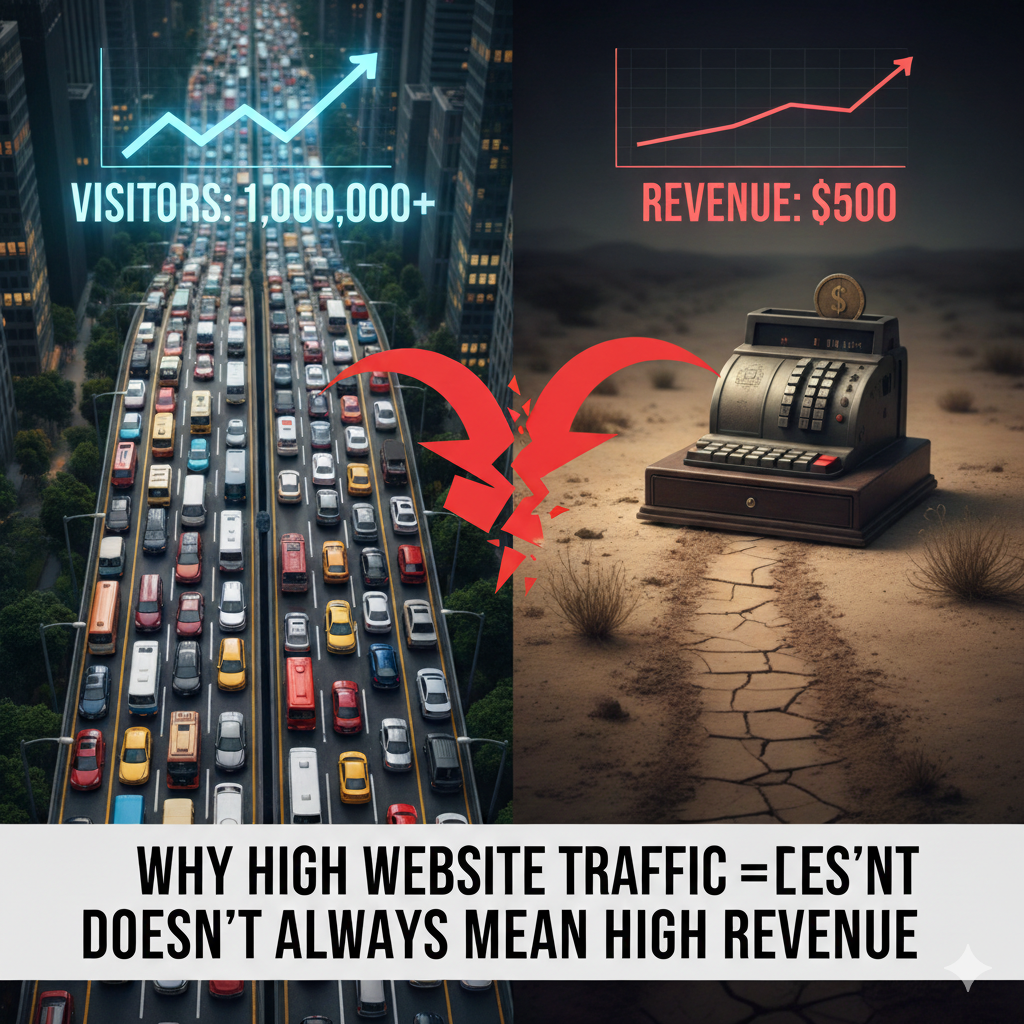
In the digital economy, website traffic is often celebrated as a primary indicator of success. Businesses proudly highlight rising visitor numbers, growing impressions, and expanding reach as proof of progress. Yet, despite impressive traffic statistics, many organizations struggle with stagnant or inconsistent revenue. The assumption that more visitors automatically translate into higher income is deeply flawed. While traffic reflects visibility, it does not guarantee conversion, profitability, or sustainable growth. Understanding the gap between traffic and revenue requires examining user intent, engagement quality, conversion efficiency, and underlying business strategy.
At first glance, high traffic appears promising because it suggests increased brand awareness. However, awareness alone does not generate income. Revenue is produced when visitors take meaningful actions such as purchasing products, subscribing to services, or submitting qualified inquiries. If traffic consists primarily of casual browsers with low purchase intent, financial returns remain limited. This highlights the importance of distinguishing between quantity of visitors and quality of visitors. Businesses that focus solely on increasing traffic may overlook whether those visitors align with their target market.
One of the most critical metrics often ignored in traffic discussions is the conversion rate. Conversion rate measures the percentage of visitors who complete a desired action. A website with 100,000 monthly visitors and a 0.5% conversion rate may generate less revenue than a website with 20,000 visitors and a 5% conversion rate. The latter demonstrates stronger alignment between audience targeting, messaging, and user experience. Without optimizing conversion pathways, high traffic simply increases server load rather than profit. Therefore, conversion optimization becomes more valuable than traffic expansion alone.
The source of traffic also plays a decisive role in determining revenue impact. Visitors arriving from organic search, paid advertising, social media, or referral links often display varying levels of intent. For example, informational blog readers may not be ready to purchase, while users searching for product-specific keywords typically demonstrate stronger buying signals. If traffic growth results primarily from low-intent channels, revenue may remain flat. Businesses must analyse traffic sources carefully to assess whether visitors possess genuine purchasing interest.
Another overlooked factor is user experience (UX). Even when traffic consists of high-intent visitors, poor navigation, slow loading speeds, or confusing checkout processes can discourage conversions. High bounce rates often indicate friction points that disrupt the customer journey. Revenue depends not only on attracting visitors but also on guiding them smoothly toward action. Technical performance, mobile responsiveness, and intuitive design significantly influence purchasing decisions. Traffic without optimized UX represents lost opportunity.
Content strategy further influences the relationship between traffic and revenue. Many organizations produce content aimed at maximizing reach rather than targeting profitable customer segments. While viral posts or trending topics may generate substantial views, they do not necessarily align with the company’s core offerings. This misalignment leads to inflated traffic metrics that fail to convert into meaningful business outcomes. A strategic content approach prioritizes relevance over volume, ensuring visitors are exposed to value propositions that encourage action.
Pricing strategy and product-market fit also determine whether traffic translates into revenue. Even with substantial visibility, products that fail to meet customer expectations or are priced inconsistently with perceived value will struggle to convert. High traffic can sometimes mask deeper issues related to value proposition and competitive positioning. Businesses must evaluate whether their offerings address genuine customer needs effectively. Traffic alone cannot compensate for weak product differentiation.
The role of customer intent is particularly significant. Visitors typically fall into different stages of the buying journey, including awareness, consideration, and decision. Traffic spikes at the awareness stage may indicate interest but not immediate purchasing readiness. Without nurturing strategies such as retargeting, email marketing, or personalized recommendations, these visitors may leave without converting. Revenue growth depends on guiding prospects through the funnel rather than merely increasing top-of-funnel volume.
Another key dimension is customer acquisition cost (CAC). Generating traffic often involves advertising expenditure, influencer partnerships, or content production investments. If the cost of attracting visitors exceeds the revenue generated from conversions, traffic growth becomes financially unsustainable. Businesses must compare CAC with customer lifetime value (CLV) to determine profitability. High traffic that generates low-value customers may actually reduce overall margins.
Data analytics provides deeper insight into why traffic fails to produce revenue. Metrics such as session duration, pages per visit, exit rates, and heatmaps reveal how users interact with content. Low engagement levels often signal disconnects between visitor expectations and website offerings. By analysing behavioural patterns, companies can identify obstacles that hinder conversions. This data-driven approach shifts focus from vanity metrics to actionable insights.
Moreover, traffic metrics can be artificially inflated through ineffective targeting or broad keyword strategies. For example, ranking for high-volume keywords unrelated to purchasing intent may drive irrelevant visitors. While search engine visibility improves, revenue does not. Precision in keyword selection and audience segmentation ensures traffic aligns with commercial objectives. Targeted traffic, even in smaller volumes, often generates stronger returns than generalized exposure.
Trust and credibility further influence revenue outcomes. Visitors may explore a website without purchasing due to concerns about reliability, security, or authenticity. Reviews, testimonials, transparent policies, and secure payment systems strengthen trust signals. Without these elements, traffic remains passive. Revenue requires confidence in both product quality and transactional security.
Retention strategy is another critical component. Revenue growth depends not only on acquiring new visitors but also on retaining existing customers. Businesses that emphasize traffic acquisition without nurturing repeat purchases limit long-term profitability. Repeat customers typically generate higher lifetime value at lower acquisition costs. Thus, sustainable revenue relies on balancing acquisition and retention efforts.
Seasonality and market conditions also affect the traffic-revenue relationship. Temporary spikes driven by promotions or external events may not reflect consistent purchasing behaviour. Businesses must differentiate between short-term traffic fluctuations and sustainable demand patterns. Long-term revenue growth depends on stable conversion systems rather than temporary visibility surges.
In competitive markets, differentiation determines whether traffic converts. If competitors offer similar products at lower prices or with superior service, visitors may compare options before making decisions. High traffic indicates interest in the category, not necessarily commitment to a specific brand. Clear differentiation through unique benefits, pricing transparency, and value communication enhances conversion potential.
The integration of predictive analytics and personalization further strengthens revenue outcomes. Personalized recommendations, dynamic content, and targeted offers increase the likelihood of conversion. Generic experiences, even with high traffic, often fail to resonate. Data-driven personalization ensures visitors encounter relevant products aligned with their interests and browsing history.
Ultimately, the misconception that traffic equals revenue stems from overreliance on surface metrics. Traffic is a leading indicator of visibility, but revenue reflects the effectiveness of the entire business ecosystem product quality, pricing strategy, user experience, trust, targeting precision, and retention mechanisms. Businesses that measure only visits risk celebrating growth that lacks financial substance.
In conclusion, high website traffic does not automatically translate into high revenue because revenue depends on conversion efficiency, visitor quality, strategic alignment, and operational excellence. Metrics such as conversion rate, customer acquisition cost, customer lifetime value, and user engagement provide more meaningful insight into financial performance. Sustainable growth emerges when businesses prioritize profitable actions rather than superficial visibility. Traffic may open the door, but revenue is earned through optimized strategy, strong value propositions, and consistent customer-centric execution.