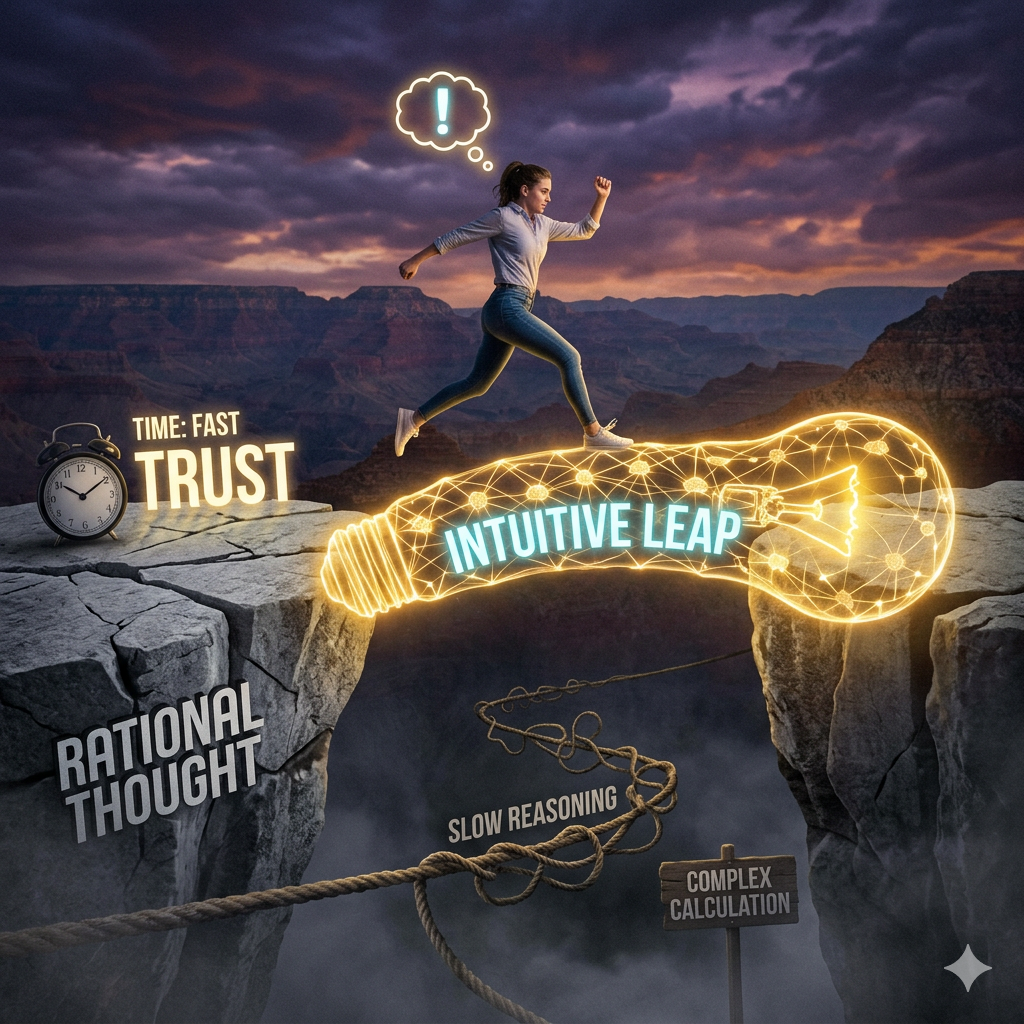
Human beings frequently rely on intuition when making decisions. Even in situations where detailed data or analysis is available, people often describe having a “gut feeling” about what the right choice might be. This instinctive judgment can influence decisions in business, relationships, and everyday life. The tendency to trust intuition is deeply connected to how the brain processes information, learns from experience, and manages uncertainty. Understanding why humans often trust their intuition reveals how cognitive shortcuts, emotional memory, and past experiences shape decision-making.
At its core, intuition is a form of rapid pattern recognition. The human brain constantly absorbs information from the environment and stores it in memory. Over time, this accumulated knowledge allows the brain to recognize familiar patterns without consciously analyzing every detail. When individuals encounter a situation that resembles something they have experienced before, the brain quickly retrieves related memories and produces an immediate judgment. This process happens so quickly that people may feel they “just know” the answer, even if they cannot explain how they arrived at it.
This ability has significant evolutionary roots. In early human environments, quick decisions often meant the difference between safety and danger. When a person sensed a potential threat in the surroundings, there was rarely time for careful analysis. The brain needed to interpret signals quickly and respond immediately. Because of this survival pressure, humans developed cognitive systems that prioritize fast decision-making. Intuition allowed individuals to act on subtle cues before fully understanding them.
Another reason intuition feels reliable is that it draws on experience-based learning. Over time, individuals accumulate thousands of small observations about how the world works. These experiences become embedded in memory and influence future judgments. For example, a skilled professional may quickly identify a problem in a project or detect an opportunity in a business negotiation without performing a detailed analysis. Their intuition reflects years of accumulated knowledge, even if the reasoning behind it is not consciously articulated.
The brain’s preference for cognitive efficiency also contributes to reliance on intuition. Analytical thinking requires time, attention, and mental effort. When people face complex decisions, the brain may prefer quicker mental shortcuts that simplify the process. Intuition provides a convenient way to evaluate situations without examining every possible detail. This efficiency can be particularly useful when decisions must be made quickly.
Emotions also play a significant role in intuitive thinking. Emotional experiences are strongly encoded in memory, and they influence how individuals interpret new situations. When a decision resembles a past experience that produced a strong emotional reaction, the brain may generate a similar emotional response. This feeling can guide intuitive judgment, encouraging people to pursue options that previously led to positive outcomes or avoid choices associated with negative experiences.
Another factor is the human need for certainty and confidence. Decisions often involve uncertainty, and complex analysis may reveal multiple possible outcomes rather than a single clear answer. Intuition can provide a sense of clarity by producing a strong internal signal that suggests a particular direction. This sense of confidence can make intuitive decisions feel more convincing than analytical ones, even when the evidence is incomplete.
Social and cultural influences can also strengthen trust in intuition. In many environments, individuals are encouraged to “follow their instincts” or “trust their gut.” Stories about successful entrepreneurs, leaders, or innovators often emphasize intuitive insight as a key factor in their achievements. These narratives reinforce the idea that intuition is a reliable guide to success.
However, intuition is not always accurate. Because it relies on mental shortcuts and past experiences, it can also be influenced by cognitive biases. For instance, individuals may remember successful intuitive decisions more vividly than incorrect ones. This selective memory can create the impression that intuition is more reliable than it actually is.
Another limitation arises when intuition is applied to unfamiliar situations. If a person lacks relevant experience in a particular area, their intuitive judgments may be based on incomplete or misleading information. In these cases, relying solely on intuition can lead to incorrect conclusions.
Despite these limitations, intuition remains an important component of human decision-making. In many situations, intuitive insights can highlight patterns or possibilities that formal analysis might overlook. When combined with careful reasoning and evidence-based evaluation, intuition can complement analytical thinking rather than replace it.
One effective approach is to treat intuition as an initial hypothesis rather than a final decision. When individuals notice a strong intuitive reaction, they can use it as a starting point for further analysis. By examining the evidence and considering alternative explanations, they can determine whether the intuitive judgment reflects a real pattern or simply a cognitive shortcut.
Organizations can also benefit from balancing intuition and data-driven thinking. Experienced professionals often develop valuable insights through years of observation and practice. When these insights are combined with structured analysis and reliable data, decision-making becomes both informed and adaptable.
Another useful strategy involves reflecting on past decisions. By examining situations where intuition led to correct outcomes and those where it produced errors, individuals can better understand the conditions under which their instincts are reliable. This reflection helps refine intuitive judgment over time.
Ultimately, humans trust intuition because it is deeply embedded in the way the brain processes information. Intuition reflects accumulated experience, emotional learning, and the brain’s natural preference for efficient decision-making. While it can sometimes produce misleading conclusions, it also enables rapid judgments that have historically supported survival and adaptation.
Recognizing the strengths and limitations of intuition allows individuals to use it more effectively. Rather than viewing intuition and analysis as competing approaches, it is often more productive to see them as complementary processes. Intuition can suggest possibilities and highlight patterns, while analytical reasoning evaluates those ideas and tests their validity.
By integrating intuitive insights with critical thinking and evidence, individuals can make more balanced decisions. In a world that increasingly emphasizes data and analytics, understanding the role of intuition helps maintain the human capacity for creativity, insight, and adaptive thinking.