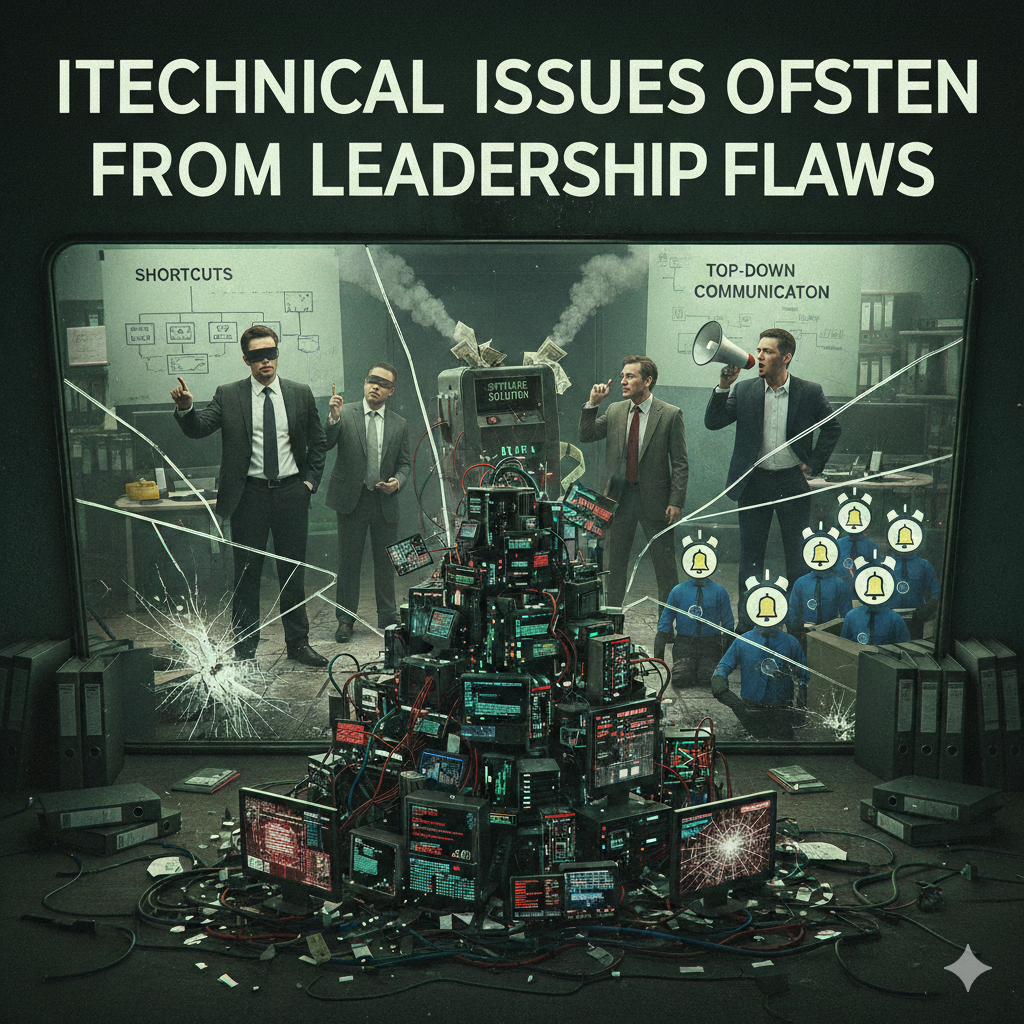
When systems crash, deadlines slip, budgets overrun, or security gaps appear, the immediate reaction is often to blame technology. The software is outdated. The infrastructure is unstable. The vendor failed. The tools are insufficient. The IT team lacks capability. But in many organizations, persistent IT issues are not rooted in technical incompetence. They stem from management decisions, unclear priorities, weak governance, or structural misalignment. Technology rarely operates in isolation. It reflects the strategy, communication, and leadership environment around it. When recurring IT problems surface, they are frequently symptoms of deeper management challenges. Below are six core reasons why IT problems are usually management problems in disguise.
1. Unclear Priorities Create Operational Chaos
One of the most common causes of IT dysfunction is shifting or conflicting priorities from leadership. When executives request urgent feature releases, demand immediate cost reduction, push digital transformation initiatives, and expect flawless system stability simultaneously, IT teams are forced into reactive mode.
Without clear prioritization:
- Projects compete for the same limited resources
- Critical maintenance is postponed
- Technical debt accumulates
- Teams rush implementation
- Quality assurance is compressed
The result is predictable: unstable systems and missed expectations. Technology teams operate within constraints of time, staffing, and budget. When management fails to establish strategic sequencing, IT departments appear disorganized — even though they are responding to inconsistent direction.
Clarity at the top reduces chaos below.
2. Underinvestment Masquerades as Technical Failure
Organizations sometimes expect enterprise-level performance from minimal infrastructure investment.
Leadership may approve ambitious digital goals while limiting funding for:
- System upgrades
- Security tools
- Skilled personnel
- Monitoring platforms
- Preventive maintenance
When outages occur or performance lags, the technical team becomes the visible target of frustration. However, sustainable technology environments require consistent investment. Hardware ages. Software evolves. Security threats advance. Workforce skills must be updated. Chronic underfunding creates fragile systems. The failure is not technological — it is financial and strategic. Management decisions determine whether IT operates proactively or merely survives reactively.
3. Poor Communication Breeds Misalignment
IT departments often operate at the intersection of multiple business units. If communication between leadership, operations, and technical teams is fragmented, alignment deteriorates.
Common management-driven communication gaps include:
- Vague project objectives
- Undefined success metrics
- Late involvement of IT in strategic planning
- Unclear change management processes
- Insufficient documentation requirements
When IT receives incomplete requirements, systems are built on assumptions. When business stakeholders fail to communicate workflow realities, software may not match operational needs. The resulting friction appears as “IT failure,” but it originates in management-level coordination gaps. Effective governance ensures that technology decisions reflect business strategy accurately.
4. Lack of Process Discipline Produces Recurring Issues
Recurring IT problems often stem from weak operational processes.
Examples include:
- No formal incident review procedures
- Inconsistent change management approvals
- Absence of risk assessment protocols
- Undefined escalation paths
- Informal vendor oversight
Without structured processes, organizations rely on improvisation. Short-term fixes replace root cause resolution. Documentation remains incomplete. Lessons from past incidents are not captured. Technology thrives on precision. Management systems that tolerate inconsistency eventually produce technical instability. Strong operational frameworks reduce recurring system failures significantly.
5. Cultural Attitudes Toward IT Shape Outcomes
In some organizations, IT is treated as a support function rather than a strategic partner. This cultural perception influences decision-making.
When leadership views IT primarily as a cost center:
- Strategic involvement decreases
- Long-term planning weakens
- Innovation opportunities are missed
- Technical warnings are minimized
IT professionals may identify future risk, scalability concerns, or security exposure. If management dismisses these insights due to short-term financial focus, problems escalate later. Culture determines whether technical insight is integrated into decision-making or sidelined. An organization that values technology strategically experiences fewer “unexpected” IT crises.
6. Accountability Structures Influence System Stability
Clear accountability prevents confusion. When ownership of systems, data, and processes is ambiguous, problems multiply:
- Who approves software changes?
- Who owns data accuracy?
- Who monitors vendor performance?
- Who validates compliance requirements?
If responsibility is diffused across departments without clarity, issues persist unresolved. In many IT breakdowns, the technical team executed according to instruction but decision authority resided elsewhere. Management must define governance structures that assign ownership explicitly. Without accountability, even well-designed systems deteriorate operationally.
The Illusion of Technical Complexity
Technology can appear complicated. However, many recurring failures originate not from complexity but from management fragmentation.
For example:
- A delayed system upgrade may reflect budget hesitation.
- A cybersecurity gap may reflect postponed approval for security tools.
- A failed implementation may reflect unrealistic timelines imposed from above.
- Overloaded IT teams may reflect staffing decisions outside their control.
Blaming technology obscures systemic causes. Addressing root management decisions often resolves persistent technical symptoms.
How Leadership Decisions Cascade Into IT Outcomes
Leadership decisions influence IT performance through several pathways:
- Resource allocation
- Priority sequencing
- Risk tolerance
- Vendor selection
- Staffing strategy
- Governance structure
When these factors are aligned with long-term objectives, IT systems stabilize and improve. When they conflict, technology becomes reactive and fragile. IT outcomes mirror executive discipline.
Why It Is Easier to Blame Technology
Blaming technology offers short-term relief. It externalizes responsibility and simplifies narratives.
Saying “the system failed” feels easier than examining:
- Unrealistic project expectations
- Compressed timelines
- Inadequate budget planning
- Insufficient cross-department coordination
- Avoided difficult strategic trade-offs
However, avoiding deeper evaluation perpetuates cycles of recurring problems. Sustainable improvement requires examining management-level causes rather than surface-level technical symptoms.
Signs That IT Problems Reflect Management Gaps
Certain indicators suggest management influence behind recurring technical issues:
- Repeated emergency fixes without long-term resolution
- Chronic project delays despite skilled personnel
- High IT staff turnover
- Frequent vendor changes
- Growing technical debt
- Escalating support tickets with similar root causes
These patterns rarely indicate isolated technical incompetence. They often signal structural misalignment. Leadership must assess systems holistically rather than attributing blame narrowly.
Moving From Blame to Structural Improvement
Organizations seeking improvement should:
- Conduct cross-functional incident reviews
- Align IT roadmaps with business strategy
- Establish realistic implementation timelines
- Allocate budget for preventive maintenance
- Define ownership clearly
- Include IT in early-stage planning discussions
When management addresses governance and alignment, many technical issues diminish naturally. Technology reflects organizational discipline.
Conclusion
IT problems are visible. Management problems are structural. The two are deeply connected. System instability, security gaps, missed deadlines, and recurring outages often trace back to leadership decisions, unclear priorities, weak communication, underinvestment, or cultural misalignment. Technology itself is rarely the sole cause. When organizations treat IT challenges as isolated technical failures, they address symptoms rather than root causes. When leadership evaluates its own decision-making frameworks, prioritization discipline, and governance structures, IT performance improves sustainably. Effective management does not eliminate all technical issues. But it prevents many from becoming chronic. In most cases, improving leadership clarity improves technology outcomes. Because behind every recurring IT failure lies a decision — and decisions originate at the management level.