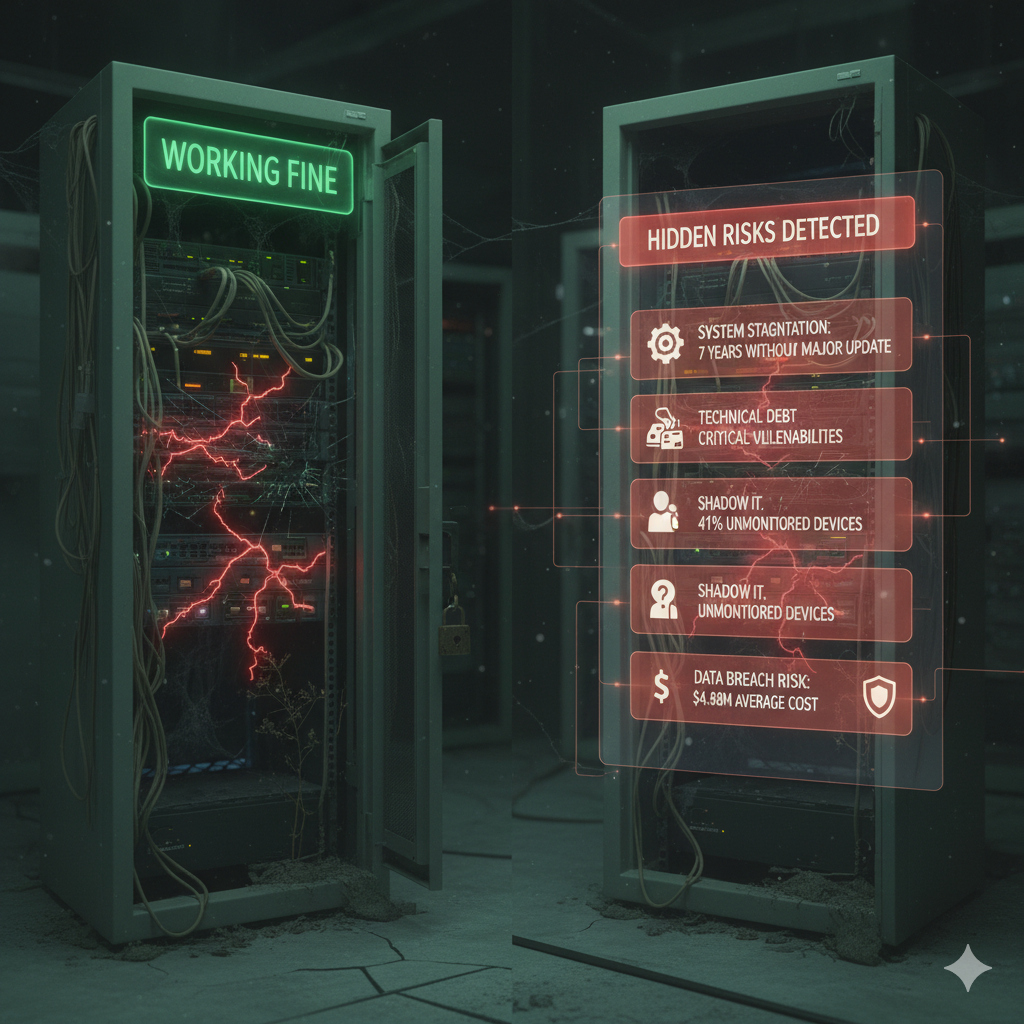
In many organizations, the most dangerous phrase in technology management is simple: “It’s working fine.” At first glance, this sounds reassuring. Systems are operational. There are no major outages. Employees can log in, applications run, and customers are being served. From a surface-level perspective, everything appears stable. However, in real-world business environments, “working fine” often hides deeper structural weaknesses. Systems that appear stable today may be outdated, vulnerable, inefficient, or incapable of supporting future growth. The absence of visible failure does not mean the presence of strength. In fact, systems that are merely “working” without optimization, modernization, or testing — often represent the greatest hidden risk to an organization.
Below are six reasons why IT systems that seem stable can quietly become long-term liabilities.
1. Stability Can Mask Obsolescence
A system that runs without crashing does not necessarily meet modern standards. Many organizations continue operating on legacy infrastructure simply because it has not failed yet.
However, outdated systems often suffer from:
- Unsupported software versions
- Expired vendor support
- Limited integration capabilities
- Incompatibility with modern tools
- Reduced performance under growing workloads
Because the system continues to function, leadership may delay upgrades. Over time, this creates technical stagnation.
The risk is not immediate failure — it is gradual decline. When modernization eventually becomes unavoidable, the cost, complexity, and disruption are significantly higher.
A system that “works” but no longer evolves with industry standards becomes a silent bottleneck to innovation and competitiveness.
2. Hidden Security Vulnerabilities Go Unnoticed
Cybersecurity risks rarely announce themselves clearly. Systems can operate smoothly while quietly accumulating vulnerabilities.
Examples include:
- Unpatched operating systems
- Weak authentication protocols
- Outdated firewall configurations
- Unmonitored access permissions
- Lack of endpoint protection updates
Attackers do not target only failing systems. They target predictable, unmonitored, and outdated ones. An organization may believe its systems are secure simply because no breach has occurred. However, the absence of visible incidents does not guarantee resilience. “Working fine” often means security has not been stress-tested not that it is strong. The biggest cybersecurity risks often exist in environments that have not been questioned or audited recently.
3. Performance That Is Acceptable Today May Be Insufficient Tomorrow
Business growth changes infrastructure demands. More users, larger data volumes, new applications, and increased remote access all place additional pressure on IT systems. A system that performs adequately today may struggle under future demand.
Warning signs often go unnoticed:
- Slightly slower application response times
- Minor delays during peak hours
- Occasional network congestion
- Increased dependency on manual processes
These issues may seem manageable, but they indicate that the system is operating close to capacity. When growth accelerates, performance degradation becomes visible and disruptive. IT infrastructure should not only support current needs but also anticipate future scale. Systems that are merely “working” often lack that scalability.
4. Lack of Documentation and Institutional Knowledge Risks
In many organizations, systems continue operating because a few experienced individuals know how to maintain them. Over time, undocumented processes become normal.
This creates several risks:
- Limited knowledge transfer
- Dependency on specific employees
- No clear recovery procedures
- Informal configuration management
As long as key personnel remain available, everything appears fine. But if someone leaves, retires, or becomes unavailable during a crisis, the organization may struggle to manage its own systems. Infrastructure that relies on memory rather than documentation is fragile. A system that “works” but is poorly documented is a ticking operational risk.
5. Reactive Maintenance Replaces Strategic Planning
When systems appear stable, IT teams often operate in maintenance mode rather than improvement mode.
Common patterns include:
- Applying temporary patches instead of root-cause fixes
- Delaying upgrades due to budget concerns
- Avoiding configuration changes to prevent disruption
- Focusing only on ticket resolution rather than optimization
Over time, this reactive approach creates technical debt. Systems accumulate small inefficiencies and outdated components that eventually compound. Because there is no visible crisis, improvement initiatives are postponed. However, the absence of planning today often creates emergency spending tomorrow. “Working fine” becomes an excuse to avoid necessary modernization.
6. Business Continuity Assumptions Are Rarely Tested
Organizations often assume their systems will recover smoothly from unexpected events because they have not experienced a major disruption yet. But assumptions are not guarantees.
Critical questions are frequently unanswered:
- Have backups been fully tested under real conditions?
- Can systems be restored within acceptable timeframes?
- Are cloud dependencies properly configured?
- Are failover mechanisms validated?
- Do employees know what to do during downtime?
A system that works daily may fail under stress. Without testing, monitoring, and simulation, leadership may overestimate resilience. The real risk is not daily performance — it is performance during crisis. Systems that appear stable can collapse under pressure if they were never designed for resilience.
The Psychological Trap of “If It’s Not Broken, Don’t Fix It”
One of the most dangerous mindsets in IT management is avoiding change simply because there is no visible failure. While the intention is to reduce risk, the result is often the opposite.
Avoiding upgrades:
- Increases long-term costs
- Reduces competitiveness
- Limits integration with modern platforms
- Weakens security posture
- Slows operational efficiency
Technology evolves rapidly. Standing still is not neutral it is regression.
Systems that are not actively improved gradually fall behind industry standards, even if they continue functioning.
How to Evaluate “Working Fine” Systems Properly
Instead of relying on surface-level stability, organizations should evaluate systems based on:
- Security posture – Are vulnerabilities assessed regularly?
- Scalability – Can infrastructure handle 2x or 3x current demand?
- Vendor support status – Are systems still officially supported?
- Performance metrics – Are there measurable slowdowns?
- Documentation quality – Can recovery occur without key individuals?
- Disaster recovery validation – Are backup and failover tested? A healthy IT environment is proactive, not passive.
Final Thoughts: Stability Without Strategy Is Risk
IT systems that are “working fine” are not necessarily strong. They may simply not have been challenged yet.
True resilience comes from:
- Continuous evaluation
- Regular upgrades
- Proactive security audits
- Capacity planning
- Structured documentation
- Tested disaster recovery plans
The goal is not to fix what is broken.
The goal is to prevent silent weaknesses from becoming visible failures. Because in technology, the most expensive problems are rarely the ones that break suddenly. They are the ones that quietly waited behind the phrase: “It’s working fine.”