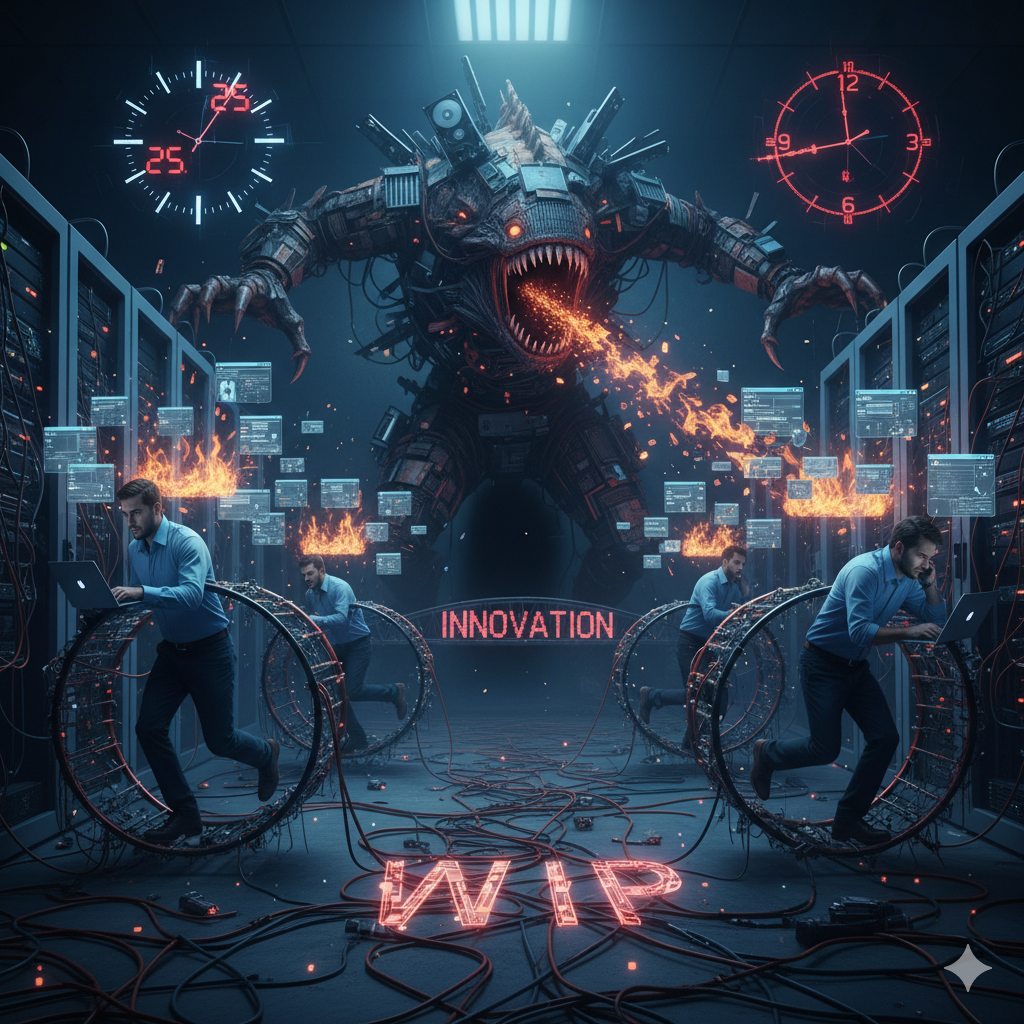
In many organizations, there is a familiar complaint that sounds almost paradoxical: the IT team is constantly busy, yet business performance, system stability, and operational efficiency never seem to improve. Servers are maintained, tickets are closed, patches are applied, and urgent issues are handled every day. Still, users feel frustrated. Leaders feel that technology is not delivering strategic value. Management begins to question productivity.
The problem is rarely about laziness or lack of skill. In most cases, IT teams are genuinely overloaded. The real issue lies in how time is spent, how priorities are defined, and how technology strategy aligns with business goals. When IT remains trapped in reactive work, long-term improvement becomes impossible. This article explores why IT teams appear perpetually busy without meaningful progress and what organizations can do to change that pattern.
1. The Trap of Reactive Work
Many IT departments operate in “firefighting mode.” Every day is filled with urgent tasks:
- Fixing email outages
- Resetting passwords
- Troubleshooting slow systems
- Responding to security alerts
- Handling user complaints
These tasks are necessary. However, when reactive work consumes the majority of available time, there is no capacity left for strategic initiatives such as automation, modernization, system upgrades, or process optimization.
Reactive environments create a repeating cycle: Problem occurs → IT fixes it → No root cause resolution → Same problem returns. Without structured root cause analysis and preventive planning, teams remain busy while system stability never improves.
2. Too Many Low-Value Tasks
Not all work creates equal impact. Many IT teams spend significant time on repetitive manual activities that could be automated.
Examples include:
- Manual data entry
- Manual reporting
- Routine server checks
- Manual software installations
- Basic ticket triaging
When automation is ignored, productivity stagnates. Instead of building tools that eliminate repetitive work, teams continue performing the same tasks daily. Over time, this creates the illusion of productivity. Activity levels remain high, but innovation remains low.
3. Lack of Clear IT Strategy
If IT does not have a defined roadmap aligned with business objectives, work becomes scattered and reactive.
Common warning signs include:
- Frequent project direction changes
- No documented technology roadmap
- Priorities shifting weekly
- Leadership introducing urgent initiatives without planning
Without structure, teams respond to whoever demands attention first. Urgent requests override important projects. Long-term initiatives are postponed repeatedly. Busyness replaces strategic progress.
4. Poor Ticket Management and Prioritization
Helpdesk systems are meant to organize workload, but in many organizations they become cluttered and inefficient.
Problems arise when:
- Tickets lack proper categorization
- No priority levels are enforced
- Escalation processes are unclear
- Old unresolved tickets accumulate
IT teams then spend time switching between tasks without completing high-impact projects. Context switching reduces efficiency and increases stress. When everything is urgent, nothing truly important gets completed.
5. Underinvestment in Infrastructure
Organizations sometimes delay investments in modern infrastructure to reduce short-term costs. However, outdated servers, unsupported software, and legacy systems create constant operational friction.
Old systems require:
- Frequent patching
- Compatibility fixes
- Manual interventions
- Custom workarounds
Instead of innovating, IT teams spend time maintaining fragile systems. Technical debt quietly drains productivity and prevents transformation.
6. Weak Communication Between IT and Business
When business leaders and IT teams do not communicate effectively, misalignment occurs.
Business leaders may expect:
- Faster feature delivery
- Immediate solutions
- Seamless integrations
Meanwhile, IT may struggle with:
- Security requirements
- Budget limitations
- Resource shortages
- Infrastructure constraints
Without alignment, IT efforts may not match business expectations. Work gets completed, but stakeholders remain dissatisfied because outcomes do not address strategic needs.
7. No Focus on Continuous Process Improvement
Continuous improvement requires:
- Performance metrics
- System monitoring
- Regular audits
- Post-incident reviews
Many IT departments skip structured reviews because they are “too busy.” Ironically, skipping process optimization ensures that recurring issues continue. Without measuring performance indicators such as downtime frequency, resolution time, and recurring incidents, teams cannot improve systems effectively. Improvement does not happen automatically it requires intentional review and redesign.
8. Resource and Skill Gaps
Sometimes the issue is not just workload but capability mismatch.
Examples include:
- A small team managing enterprise-level infrastructure
- Security responsibilities assigned without dedicated experts
- Cloud migration projects handled without sufficient training
When staff lack proper tools or expertise, tasks take longer and results become inconsistent. Workload increases, but outcomes remain average.
9. Absence of Automation and Modern Tools
Modern IT environments rely heavily on automation tools for:
- Monitoring
- Deployment
- Backup management
- Security scanning
- Configuration management
Without automation, IT teams perform tasks manually, increasing human error and reducing speed. Organizations that avoid investing in automation often experience stagnation, even when teams work overtime. Efficiency does not improve because processes remain outdated.
10. Constant Interruptions and Context Switching
IT professionals are frequently interrupted by:
- Phone calls
- Urgent walk-ins
- Emergency emails
- Unplanned meetings
Research consistently shows that context switching significantly reduces productivity. When deep work is constantly interrupted, complex projects remain incomplete. The team appears busy throughout the day but produces minimal strategic progress.
The Real Cost of Continuous Busyness
When IT teams remain in survival mode:
- Innovation slows
- Employee morale declines
- Burnout increases
- Security risks grow
- Competitive advantage weakens
High activity without measurable improvement damages both operational stability and long-term growth. Over time, organizations may lose trust in their own technology capabilities.
How to Shift from Busy to Effective
Solving this issue requires structural change, not simply harder work.
Implement Root Cause Analysis
After major incidents, conduct formal reviews. Identify patterns and eliminate the source of recurring issues instead of repeatedly fixing symptoms.
Prioritize Automation
Identify repetitive tasks and automate them systematically. Even small automations can free significant time over months.
Create a Clear IT Roadmap
Align technology initiatives with business goals. Define quarterly and annual objectives. Document priorities and communicate them clearly.
Improve Ticket Categorization and Prioritization
Introduce strict priority levels and structured escalation paths to prevent overload and confusion.
Invest in Modern Infrastructure
Upgrade outdated systems strategically to reduce maintenance burden and long-term operational costs.
Allocate Time for Innovation
Schedule dedicated hours weekly or monthly for improvement projects and system optimization.
Measure What Matters
Track key metrics such as:
- Incident recurrence rate
- Resolution time
- System uptime
- Project completion rate
- Automation coverage
Data-driven management enables real improvement.
Conclusion
An IT team that is constantly busy is not necessarily productive. Persistent busyness often signals deeper structural problems reactive operations, lack of strategy, technical debt, skill gaps, and insufficient automation.
Real improvement requires shifting from short-term firefighting to long-term planning. When organizations align IT strategy with business objectives, invest in modernization, and protect time for innovation, the results become measurable. Technology should drive progress, not merely maintain survival. If your IT team is always working but nothing seems to improve, the solution is not more effort. It is better structure, smarter prioritization, strategic alignment, and intentional investment in sustainable improvement.